
How Acoustic Panels Control Pump Noise in Well Enclosures
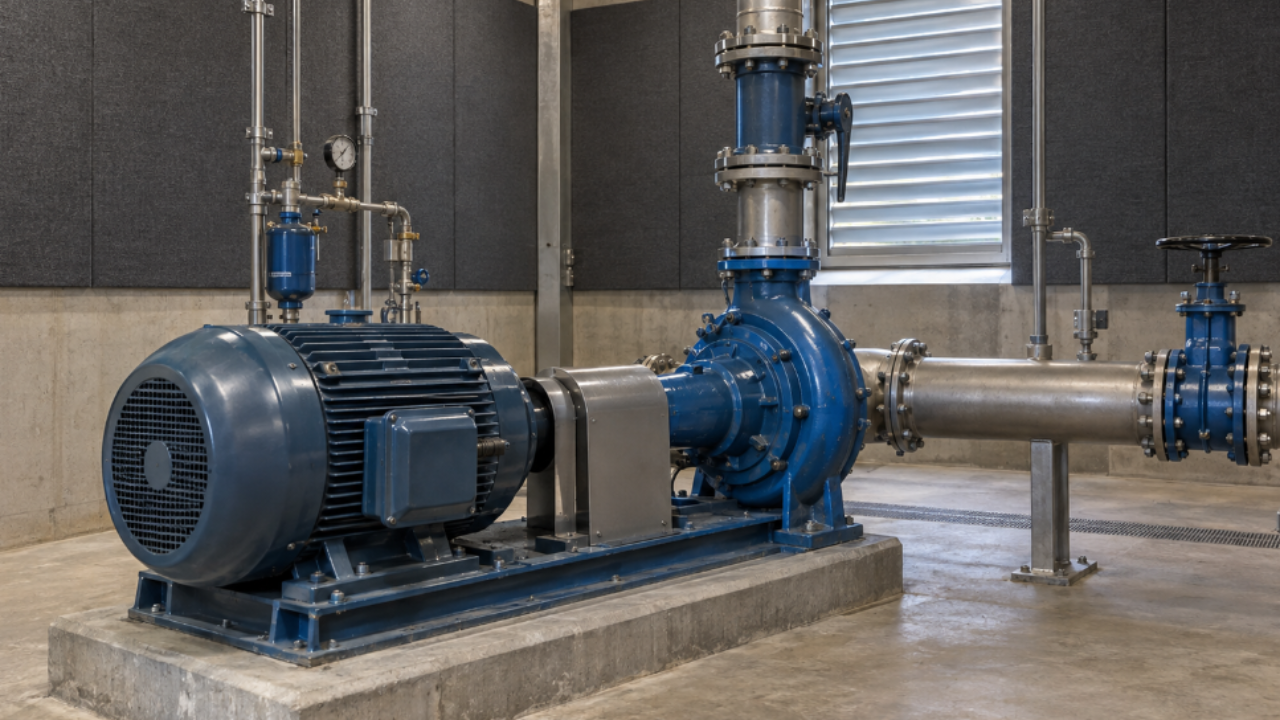
A well enclosure can make pump noise harder to control because its small volume and hard surfaces repeatedly reflect sound back toward the equipment. Those reflections combine with vibration, ventilation openings, and mechanical penetrations to create several paths for noise to reach nearby residential property. Controlling pump noise starts by separating sound blocking, sound absorption, and vibration isolation instead of treating all three as “soundproofing.”
Which Acoustic Mechanism Controls Each Noise Path?
Calling every noise-control measure “soundproofing” hides the distinction that determines whether a well-enclosure treatment will work.
Sound blocking limits airborne sound transmission through a physical barrier. Airborne sound is acoustic energy that travels through the air from a source to surrounding surfaces or receivers.
Sound absorption reduces reflected acoustic energy within a space. Absorption panels and sound-absorptive linings perform this function inside an enclosure.
Vibration isolation reduces mechanical energy transferred from operating equipment into connected structures. Isolation mounts, resilient supports, and flexible pipe connectors are common ways to address that path.
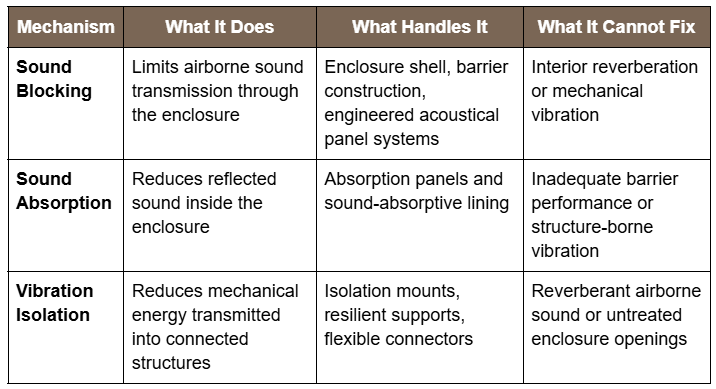
Specifying absorption for a barrier or vibration path leaves the actual transmission mechanism untreated. If that mismatch is discovered after construction, the project may need additional barrier, isolation, or ventilation work that could have been coordinated earlier. Some engineered acoustical panel systems combine absorption and blocking, but the two mechanisms still perform different acoustic jobs.
Why Can a Pump Measure Louder Inside Its Enclosure?
A compact enclosure changes the acoustic environment around the pump. Concrete block, sheet metal, and other hard surfaces return much of the pump’s acoustic energy to the room. Instead of radiating away, that energy continues reflecting between the enclosure boundaries.
A reverberant sound field is the acoustic field created by those repeated reflections. The resulting interior sound pressure can exceed what the same source would produce without nearby reflective boundaries, depending on enclosure geometry, surface absorption, source location, frequency, and measurement position.
What Do Absorption Panels Actually Change?
Interior absorption reduces the reverberant sound field and, with it, the reflected sound energy reaching enclosure walls, doors, vents, and penetrations.
This is where absorption panels perform their specific job. They make the interior acoustic environment easier for the complete enclosure system to control.
They do not replace the enclosure shell. They also do not become a mechanical vibration-control system simply because they reduce airborne sound inside the space.
Where Does Pump Noise Escape After the Walls Do Their Job?
Improving the wall assembly does not remove the other paths through the enclosure. Doors, ventilation openings, pipe penetrations, construction gaps, and similar discontinuities can carry significant airborne sound to the exterior.
Transmission loss describes how much a barrier reduces sound passing through it. As transmission loss through the main enclosure shell increases, untreated openings and weaker assemblies can become increasingly important to total system performance.
That is why specifying a heavy wall or high-performing acoustical panel system is only part of the design process. A well enclosure performs as a complete assembly, and its weakest acoustic paths may govern the sound that ultimately reaches nearby property.
Why Can’t Interior Absorption Stop Pump Vibration?
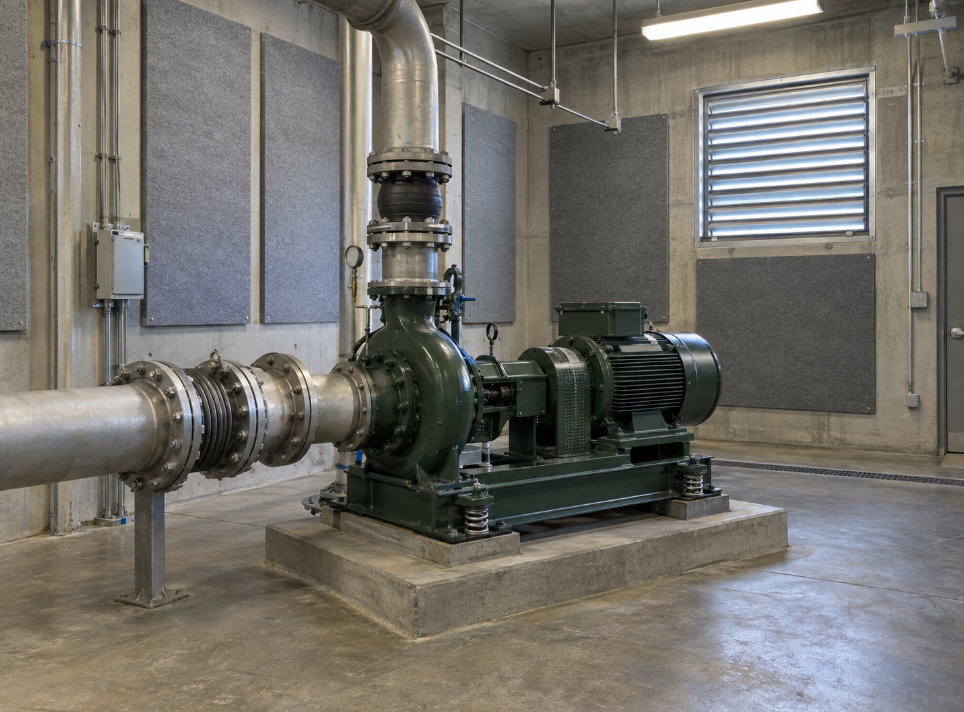
Pump noise does not travel exclusively through the air. Rotating equipment can transmit vibration through equipment bases, the slab, structural supports, and connected discharge piping.
Structure-borne noise occurs when mechanical vibration travels through a solid structure and causes another surface to radiate sound. Interior absorption cannot interrupt that mechanical transmission path.
If vibration is entering the slab, the response may require appropriate equipment isolation. If rigid piping is carrying vibration away from the pump, properly selected flexible connectors or other mechanical isolation measures may be required.
An enclosure can contain airborne noise effectively and still leave a structure-borne path untreated. Adding more absorptive material will not correct a problem whose controlling mechanism is mechanical vibration.
How Do You Ventilate a Well Enclosure Without Opening a Path for Noise?
Ventilation cannot simply be eliminated because the pump and motor still have heat-rejection requirements. The design task is to preserve required airflow while attenuating the sound path created by that airflow opening.
An acoustical louver is a ventilation component designed to attenuate sound passing through an opening while permitting airflow through the enclosure. Acoustical louvers address the airflow path, while interior absorption can reduce reflected energy reaching that opening.
Neither function should be confused with the other. Covering a vent with absorptive material is not a substitute for engineering the required airflow and acoustic attenuation together.
Which Acoustic Treatments Can Handle Well-Enclosure Conditions?
Acoustic performance is only one part of selecting treatment for a well enclosure. The materials also have to remain suitable for the physical environment in which they will operate.
Humidity, condensation, corrosion exposure, cleaning practices, and water contact can affect panel materials, facings, liners, and acoustic fill. Where a well site has long intervals between close inspections, material and facing durability becomes particularly important to maintaining the intended acoustic treatment.
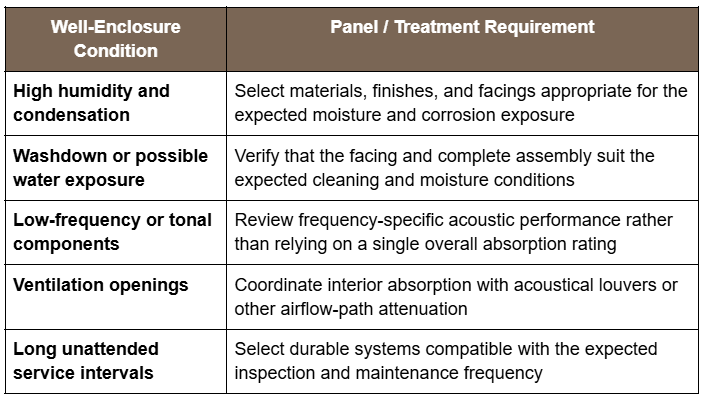
A moisture-resistant facing does not automatically establish that an entire panel assembly is suitable for standing-water exposure. The specification should match the expected environmental condition rather than assuming all acoustic products tolerate the same service.
Where persistent moisture creates a mold concern, mold-resistant acoustical fill and appropriate corrosion-resistant materials may be part of the specification.
Where Should the Acoustic Target Be Set?
The acoustic target is the site-specific sound criterion the completed system is expected to meet at the controlling receiver. For a municipal well site, that target should begin at the location where acoustic performance will actually be evaluated. An arbitrary sound level measured inside the enclosure does not establish success when the governing requirement applies outside it.
A controlling receiver is the location at which the applicable acoustic criterion governs the required system performance. Depending on the project, that location may be a property line, nearby residence, or another designated noise-sensitive receptor.
For continuous operation at a remotely monitored well site without a continuously occupied workspace, the exterior criterion at the property line or another noise-sensitive receiver may drive the site acoustic target more directly than an employee-exposure limit. Occupational noise exposure still needs separate consideration when personnel enter the enclosure for inspection, maintenance, or repair.
Once the controlling receiver is known, the design can work backward through every path connecting it to the pump. The shell addresses airborne transmission, interior absorption controls reflected energy, isolation addresses mechanical vibration, and acoustical louvers treat necessary airflow openings.
That analysis tells the engineer what actually needs to be specified. Starting with a predetermined quantity of acoustic panels does not.
Once the receiver and criterion are defined, the source spectrum becomes equally important because overall level alone may not describe the acoustic condition the project must control.
Tonal Noise Can Change the Assessment
Pump systems can also produce substantial low-frequency sound, meaning acoustic energy concentrated toward the lower end of the audible spectrum. Low-frequency performance deserves separate attention because enclosure assemblies and absorptive treatments do not provide the same attenuation at every frequency.
Tonal noise contains a distinct frequency component that stands out from the surrounding sound spectrum. Depending on pump type and operating condition, a pump system can produce pronounced components associated with shaft rotation, motor operation, resonance, and, in centrifugal pumps, blade- or vane-passing frequency.
The exact acoustic signature varies with equipment and operating conditions. It should therefore be evaluated rather than assumed.
An A-weighted sound level is a sound-pressure measurement adjusted to approximate the frequency sensitivity of human hearing. Prominent tones deserve additional attention because some environmental-noise standards and local requirements apply special corrections or criteria when tonal characteristics are present. Overall A-weighted sound level may therefore be only one part of determining the appropriate site target.
Acoustic Planning Works Best Before the Enclosure Is Fixed
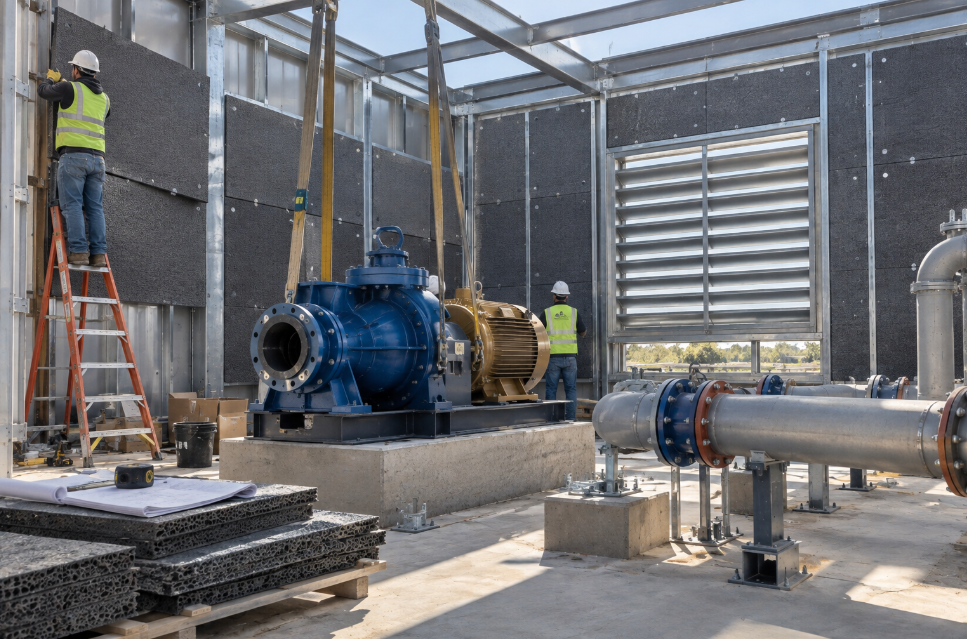
Acoustic planning has the greatest design flexibility before enclosure geometry, mechanical interfaces, and ventilation routes are finalized. Before construction, the team can still move an opening, change an enclosure assembly, adjust equipment interfaces, or provide space for attenuation. After complaints begin, many of those choices may already be concrete, steel, piping, and installed equipment.
Where residential development expands around an existing utility parcel, a well site that once had substantial separation from neighbors can face a different acoustic context. Waiting for complaints means solving the problem after much of the site design is already committed.
The acoustic target should be established before products are selected, while openings, assemblies, equipment interfaces, and attenuation space can still be coordinated around it.
Bring Acoustic Design In Before the Remaining Choices Narrow
Commercial Acoustics can help evaluate the acoustic target for a specific well site and determine how the enclosure system should respond. Depending on the identified paths, that may involve engineered acoustical panels or equipment enclosures for containment and absorption, along with acoustical louvers where ventilation openings require attenuation.
Frequently Asked Questions
Do Acoustic Panels Block Pump Noise or Absorb It?
Interior absorption panels primarily reduce reflected sound inside the well enclosure; they do not replace the enclosure shell or mechanical vibration isolation. Some engineered acoustical panel systems can combine absorption and blocking, so performance depends on the specific assembly.
Why Is Pump Noise More Likely to Draw Complaints Than Other Equipment Noise?
Pump noise can become especially noticeable when it contains prominent tonal components that stand out from surrounding broadband noise. Some acoustic assessment methods also treat prominent tones differently, making the equipment spectrum relevant to the site target.
Will Acoustic Panels Inside a Well Enclosure Restrict Ventilation?
Properly located interior absorption does not have to obstruct the designed airflow path. Ventilation openings may still require acoustical louvers or other attenuation so airflow and noise control are handled together.
Do Acoustic Panels Reduce Pump Vibration?
No. Absorptive panels reduce reflected airborne sound, while vibration transmitted through the slab, supports, or piping requires mechanical isolation.
Can Acoustic Treatment Be Added to an Existing Well Enclosure?
Yes, but the correct retrofit depends on the controlling noise path, available space, ventilation, wall construction, equipment mounting, and environmental conditions. Diagnosis should come before simply adding more absorption.