
Generator Acoustic Enclosure Design Guide

Generator noise travels fast. When backup or prime power equipment sits near patient areas, offices, property lines, or mission-critical facilities, poor planning can create complaints, overheating risk, service-access conflicts, and redesign costs. Generators can produce sound levels above 100 decibels at the source, comparable to a jackhammer, while most regulations call for 65 to 75 decibels at the property line. Meeting that gap requires more than a simple barrier around the unit. This guide explains how generator acoustic enclosure design balances sound control, airflow, heat dissipation, vibration isolation, access, weather protection, and long-term generator performance.
What Generator Acoustic Enclosure Design Needs To Accomplish
Generator acoustic enclosure design is the process of reducing generator noise while preserving the airflow, cooling, access, durability, and operating conditions the equipment needs. The enclosure body, openings, exhaust paths, and ventilation components have to work as one connected system.
Core Enclosure Goals
The main goal is to reduce noise emissions before that sound reaches nearby occupants, workers, neighbors, or sensitive operations. Effective generator acoustic enclosure design also supports equipment performance by protecting airflow paths, allowing heat to escape, preserving access for service, and keeping the assembly durable under the site’s weather and operating conditions.
A well-planned generator acoustic enclosure should help project teams manage:
- Sound attenuation
- Operational reliability
- Compliance support
- Occupant and community protection
A layout that blocks sound but restricts cooling air creates a different failure point, and poor access can weaken acoustic integrity once technicians start removing panels or leaving doors open during service.
Why Generator Noise Requires Multi-Path Control
Generator sound has to be reviewed as a set of connected paths rather than a single noise source.
Primary Generator Noise Sources
Generators produce noise from several sources at the same time. Engine operation, cooling fans, alternators, intake air, exhaust discharge, and vibration through the skid or structure can all contribute to the total sound profile.
That matters because a single barrier rarely addresses every sound path. A dense wall assembly may reduce direct airborne noise from the engine, but fan openings, exhaust routing, loose penetrations, or unsealed access doors can still allow sound to escape. Structure-borne vibration can also travel through supports and surrounding surfaces, then re-radiate as audible noise unless isolation details at the skid, supports, exhaust connections, or surrounding structure interrupt that mechanical energy.
Application-Specific Noise Concerns
Commercial, industrial, healthcare, data center, utility, and emergency power sites often increase the challenge. A hospital generator may be close to occupied rooms, a data center unit may operate near a property line, and utility or emergency power installations may need noise control during runtime events that affect nearby workers, neighboring properties, or critical operations. Each situation changes the acceptable noise target, airflow demand, and enclosure configuration.
Sound Attenuation Requirements Should Be Defined Early
Because generator noise moves through several paths, sound attenuation has to be planned around the source, the enclosure, and the nearby receptors.
Setting The Sound Target
Sound attenuation requirements should be identified before the enclosure is designed, fabricated, or installed. The target depends on the generator, the load condition, the surrounding site, the distance to nearby receptors, and the expectations of local authorities, facility owners, or project specifications.
Community noise ordinances typically set daytime property-line limits between 65 and 75 dB(A), with stricter thresholds of 45 to 55 dB(A) at night in residential or mixed-use zones. Workplace exposure adds another benchmark: OSHA sets a 90 dB(A) permissible exposure limit over an 8-hour period, and NIOSH recommends a lower 85 dB(A) limit for the same period. In generator acoustic enclosure design, the sound target should guide the enclosure layout instead of being treated as a late-stage adjustment.
Coordinating The Sound Paths
A project with a generator facing an open industrial yard will not have the same acoustic challenge as a unit placed between reflective building walls or near occupied healthcare space. Sound attenuation typically comes from a coordinated group of features.
Dense, multi-layer wall assemblies, for example a steel shell lined with mineral wool and mass-loaded vinyl, combine reflection and absorption to lower sound transmission. Mineral wool typically reaches absorption coefficients above 0.90 at frequencies over 500 Hz, while mass-loaded vinyl acts as a limp barrier that resists the 125 to 250 Hz hum common in generator output. Combined into sandwich panels, these materials can deliver 25 to 30 dB of insertion loss in real-world use. Acoustic louvers and sound attenuators treat intake and discharge openings. Exhaust mufflers address one of the loudest paths from combustion equipment. Gasketed acoustical doors and sealed penetrations help keep the system from leaking sound at weak points.
Ventilation, Airflow, And Heat Dissipation
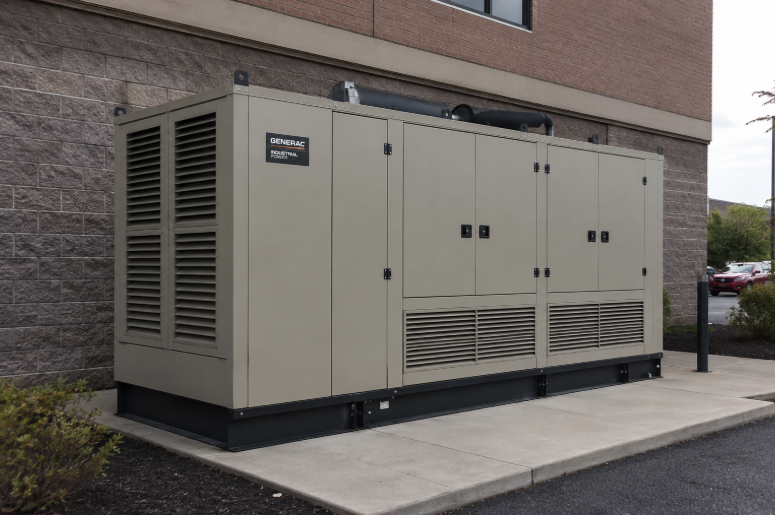
Airflow design has to account for both the sound leaving through openings and the heat the generator must reject during operation.
Why Air Openings Need Acoustic Treatment
Treating openings for sound also changes how air moves through the enclosure. In generator acoustic enclosure design, airflow and noise control have to be planned together because every intake, discharge, and ventilation path can also become a path for sound to escape.
Airflow requirements are calculated from engine displacement and cooling system design; a large standby generator can require more than 20,000 cubic feet per minute of airflow. If louvers, baffles, ducts, or attenuators are undersized or poorly arranged, the generator may face higher internal temperatures or reduced cooling performance, which can affect reliability during long runtime events, emergency operation, or high-load industrial use. Computational fluid dynamics modeling can help predict air movement, identify hot spots, and place inlets and outlets so the design meets NFPA and manufacturer ventilation requirements without giving up acoustic performance.
How Heat And Recirculation Affect Layout
The enclosure should route air through components that allow movement while reducing sound transmission. Acoustic louvers, intake silencers, discharge attenuators, and properly planned ventilation modules help support that balance.
Heat dissipation also affects layout. Hot discharge air needs a clear path away from the enclosure so it does not recirculate into the intake side. In tight mechanical yards, rooftop installations, or screen-walled equipment areas, nearby surfaces can redirect hot air back toward the generator, so that condition should be addressed before approval.
Vibration Isolation And Structure-Borne Noise
Even a heavily insulated enclosure can fall short of its target if structure-borne vibration is not addressed separately from airborne sound. Vibration from the skid can transmit into foundations and surrounding structures, then re-radiate as audible noise in adjacent spaces.
Resilient mounting systems, rubberized pads, and spring isolators decouple the generator and enclosure from structural connections. Well-designed spring isolators can reduce vibration transmission by 80 to 95 percent at operating frequencies. Accelerometer testing on slabs, support frames, and structural members can confirm that vibration stays below the levels that could disturb nearby equipment or occupants, which matters for hospitals, data centers, and other facilities where sensitive operations sit close to the generator.
Access, Maintenance, And Long-Term Serviceability
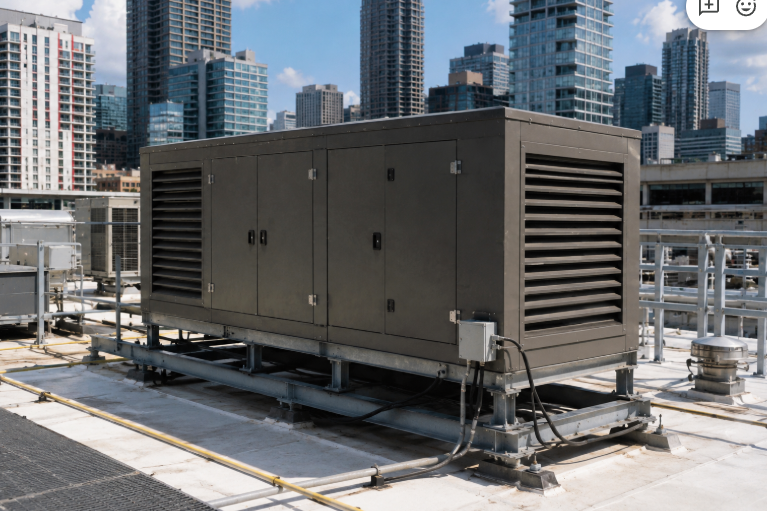
Once airflow and heat movement are protected, the enclosure still has to work for the people who maintain the generator. Maintenance access belongs in the design from the start. Generators require inspections, filter changes, oil service, control access, battery checks, and occasional component replacement.
Service Access And Acoustic Integrity
If technicians cannot reach those areas easily, field work can compromise the enclosure. Access doors, removable panels, service hatches, and inspection points should align with the generator’s actual maintenance points. Those openings also need acoustic seals and hardware that support repeated use.
A door may seal well on day one, but if routine service makes it difficult to close, it can become an ongoing sound leak. A tightly planned layout protects the sound-control strategy during regular maintenance and reduces the chance that crews will remove acoustic treatment, cut new openings, or leave access points unsecured because the original design did not match field service needs.
Meeting Noise Regulations And Verification
Compliance depends on both community ordinances and workplace safety limits, and it has to hold up after commissioning, not just at the time of the first test.
Testing is typically conducted at standardized distances, often 7 or 23 feet from the source, to give code officials and facility managers a measurable benchmark. Several protocols support that verification: ISO 3744 determines sound power levels using pressure measurements, ISO 9614 uses intensity measurements for more detailed acoustic mapping, and ASTM E336 is a field test method for airborne sound transmission. Many facilities also build ongoing sound surveys into preventive maintenance programs, since materials weather and seals degrade over time, and a design that passes at commissioning can drift out of compliance years later without periodic checks.
Weather Protection And Material Selection
Outdoor generator enclosures must account for exposure, material durability, and structural conditions before acoustic details are finalized.
Matching Materials To Exposure
Outdoor generator enclosures must withstand environmental exposure as well as sound pressure. Rain, wind, snow, corrosion, sunlight, temperature swings, and airborne contaminants can affect panels, seals, fasteners, insulation, doors, and finishes.
Material selection should reflect exposure conditions. Galvanized steel, aluminum, stainless steel, coated finishes, and reinforced panel assemblies may be considered when the project requires added corrosion resistance, strength, or durability. The enclosure also needs to keep acoustic fill materials dry, since moisture can saturate absorptive cores and reduce performance over time. Elastomeric coatings help prevent UV degradation, perforated metal facings protect insulation from impact damage, and drainage layers keep materials like mineral wool dry so their absorption properties hold up over decades of service.
Planning For Structural Conditions
Custom generator acoustic enclosures may include double-wall modular acoustical panels, acoustical doors, treated openings, mufflers, powered ventilation systems, vibration isolation, and project-specific structural features. The right combination depends on the generator, installation environment, structural exposure, and acoustic target.
A field-erected enclosure in an exposed location may need different reinforcement than a drop-over enclosure placed in a protected service yard, and rooftop installations can add wind and access concerns.
Site-Specific Noise Considerations
The same site conditions that affect durability also shape how generator noise moves after it leaves the enclosure.
Receptors And Reflections
Distance, elevation, surrounding walls, nearby buildings, reflective surfaces, ground conditions, and property-line locations all influence the final noise level. A generator in an open yard may disperse sound differently than one located between concrete walls, and a rooftop generator may project sound across a wider area.
Ordinances And Project Requirements
Project teams should identify sensitive receptors, such as workers, building occupants, neighboring properties, patients, students, tenants, or nearby control rooms, during early site planning. Local sound ordinances, owner requirements, and project specifications should also be confirmed before the team finalizes enclosure assumptions, so the acoustic plan can address the actual sound paths instead of relying on a generic assumption.
Facility type changes the target considerably. Healthcare facilities often need levels below 55 dB(A) in patient areas, tied to both patient comfort and standards such as the FGI Guidelines, alongside privacy expectations under HIPAA. Data centers add vibration isolation to the list of concerns, since uncontrolled vibration can affect server accuracy and threaten uptime commitments, which is why many facilities follow Uptime Institute Tier standards or ANSI/TIA-942 guidance for resilient mounting and slab isolation. Urban commercial sites frequently face the strictest ordinances of all, with nighttime limits as low as 45 to 50 dB(A) at the property line under municipal or EPA-influenced noise regulations, where vestibule entries, ducted silencers, and tuned absorbers help maintain both compliance and community relationships.
Common Generator Enclosure Design Challenges
Common design problems usually appear when acoustic, mechanical, and service requirements are handled in separate conversations. Noise control, cooling, access, weather exposure, and exhaust routing all need to be reviewed together.
The most frequent challenges include:
- Defining the sound target after the generator and enclosure layout are already selected
- Adding acoustic treatment without checking airflow restriction
- Treating intake and discharge openings as mechanical details instead of acoustic paths
- Overlooking exhaust noise until late in the project
- Placing access doors where technicians cannot use them efficiently
- Using materials that do not match outdoor exposure or project durability requirements
- Ignoring nearby reflective surfaces that can increase perceived noise
- Selecting a generic enclosure for a constrained or sensitive site
These issues are avoidable when the project team defines the acoustic target, generator operating needs, and site constraints before approving the enclosure design.
When Custom Generator Enclosure Design Makes Sense

Standard enclosure selection should be tested against the site’s acoustic, mechanical, and access constraints before the project commits to fabrication.
Project Conditions That Call For Custom Design
Custom generator acoustic enclosure design becomes especially useful when the project has strict noise expectations, limited space, unusual airflow paths, sensitive nearby occupants, harsh outdoor exposure, or generator-specific service needs. A standard enclosure may reduce sound in a basic installation, but it may not address the full combination of acoustic, mechanical, structural, and access requirements.
Configuring The Enclosure Around The Site
Custom equipment enclosures can be configured around the generator and the site instead of forcing the site to accept a preset enclosure. That can include drop-over units, skid-mounted systems, field-erected structures, acoustic louvers, sound attenuators, mufflers, acoustical doors, ventilation modules, and material choices suited to the environment.
This broader generator enclosure design process helps engineers, facility managers, contractors, and planners make better decisions before fabrication. It clarifies what the enclosure must reduce, what the generator must still do, and what conditions the system has to withstand once installed.
Questions To Ask Before Approving A Generator Enclosure Design
A design review turns assumptions into usable specifications. Before approving the enclosure, project teams should ask:
- What sound level does the project need to meet, and where will it be measured?
- Which generator noise paths require treatment: engine, fan, intake, exhaust, structure, or openings?
- Have intake and discharge airflow requirements been checked against the acoustic components?
- Can hot discharge air leave the area without recirculating into the intake path?
- Do technicians have clear access to filters, controls, batteries, oil service points, and major components?
- Are doors, removable panels, penetrations, and seams sealed for acoustic performance?
- Are materials and finishes appropriate for rain, wind, corrosion, sunlight, or rooftop exposure?
- Does the layout account for nearby occupants, property lines, reflective surfaces, and community noise concerns?
Those answers give the enclosure manufacturer, project engineer, contractor, and facility team a shared basis for procurement and fabrication.
Plan Custom Generator Noise Control With Commercial Noise Control
Generator enclosure planning works best when acoustic, mechanical, service, and site requirements are reviewed together. Commercial Noise Control works with project teams that need custom generator acoustic enclosures and engineered noise control solutions for demanding commercial and industrial environments. Contact us today for more information.