
Industrial Noise Control: Engineering Solutions for Noise and Vibration Reduction
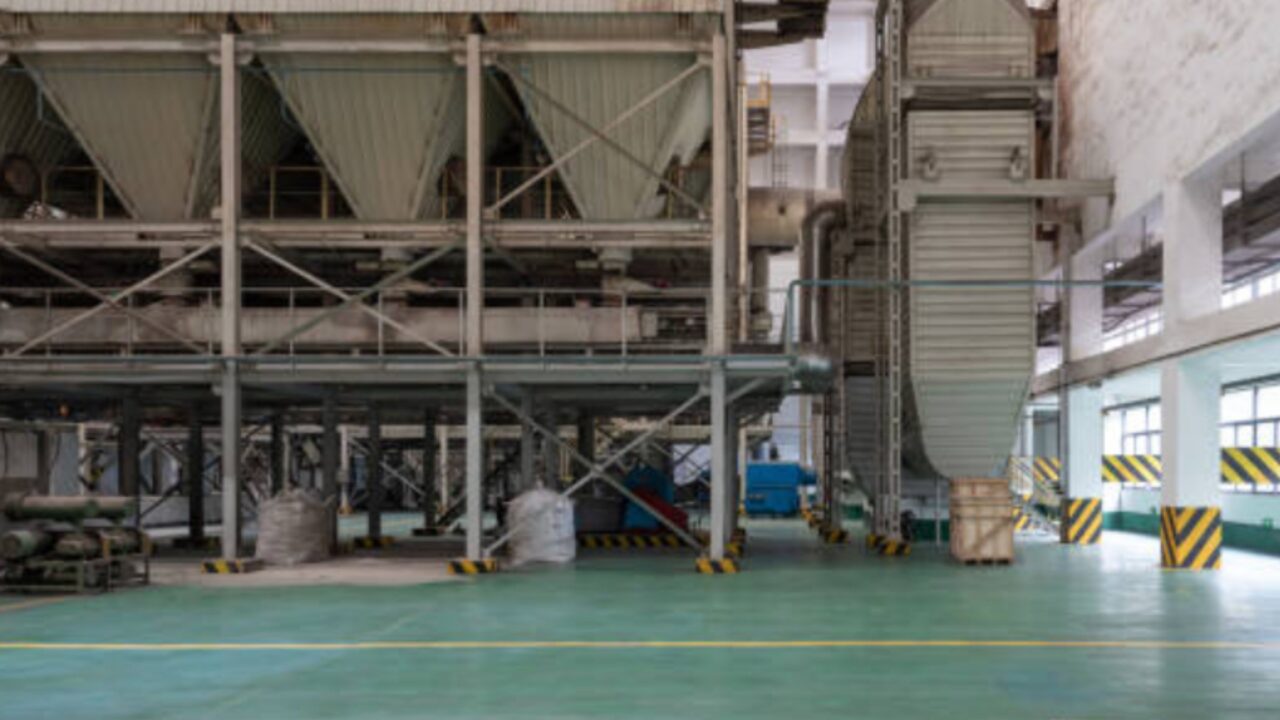
Every industrial facility operates under constant acoustic and mechanical pressure. Motors, pumps, and compressors generate layers of noise and vibration that move through floors and framing. Effective industrial noise control addresses airborne sound and structure-borne motion together to protect workers and maintain compliance with regulatory limits across manufacturing and commercial facilities.
Why Industrial Noise and Vibration Control Matter
Industrial environments often exceed OSHA’s action level of 85 dBA (TWA), triggering hearing conservation requirements. In daily operation, these levels can contribute to fatigue, hearing strain, and may interfere with speech intelligibility. As exposure rises, hearing fatigue increases, which in turn reduces concentration and safety awareness on the floor.
- Vibration presents its own hazards.
- Equipment mounted directly to rigid floors transfers energy that loosens fasteners, shortens bearing life, and increases maintenance intervals.
- Resonance within frames can amplify motion and produce fatigue cracks in welds.
- Controlling both noise and vibration maintains equipment integrity and ensures the facility meets environmental noise limits and occupational exposure standards.
Regulatory compliance adds another layer of responsibility. Many municipalities restrict property-line noise (rules vary widely by jurisdiction), while industrial clients demand documentation per ASTM E90 (sound transmission loss) or ISO 20816 (formerly 10816, vibration severity). Integrated control measures demonstrate measurable compliance and reduce long-term liability.
Sources of Industrial Noise and Vibration
Noise and vibration originate from mechanical movement, airflow, and process operations. Each behaves differently and demands targeted mitigation.
Airborne Noise
Airborne sound comes from moving air, cutting tools, and mechanical friction. Fans, pneumatic lines, and high-speed motors generate broad-frequency energy that reflects off walls and ceilings. Without absorption, this energy accumulates, raising background levels. Acoustic treatment converts sound energy into heat within porous or fibrous media, measured by its Noise Reduction Coefficient (NRC).
Structure-Borne Vibration
Structure-borne vibration travels through steel, concrete, and framing. Rotating or reciprocating machines transmit dynamic forces into supports, which then radiate secondary noise. For instance, a 30 Hz pump vibration can cause connected metal panels to emit low-frequency sound even if the pump itself is enclosed. Effective mitigation relies on isolators and damping layers tuned to the dominant excitation frequency.
Core Solutions for Industrial Noise Control
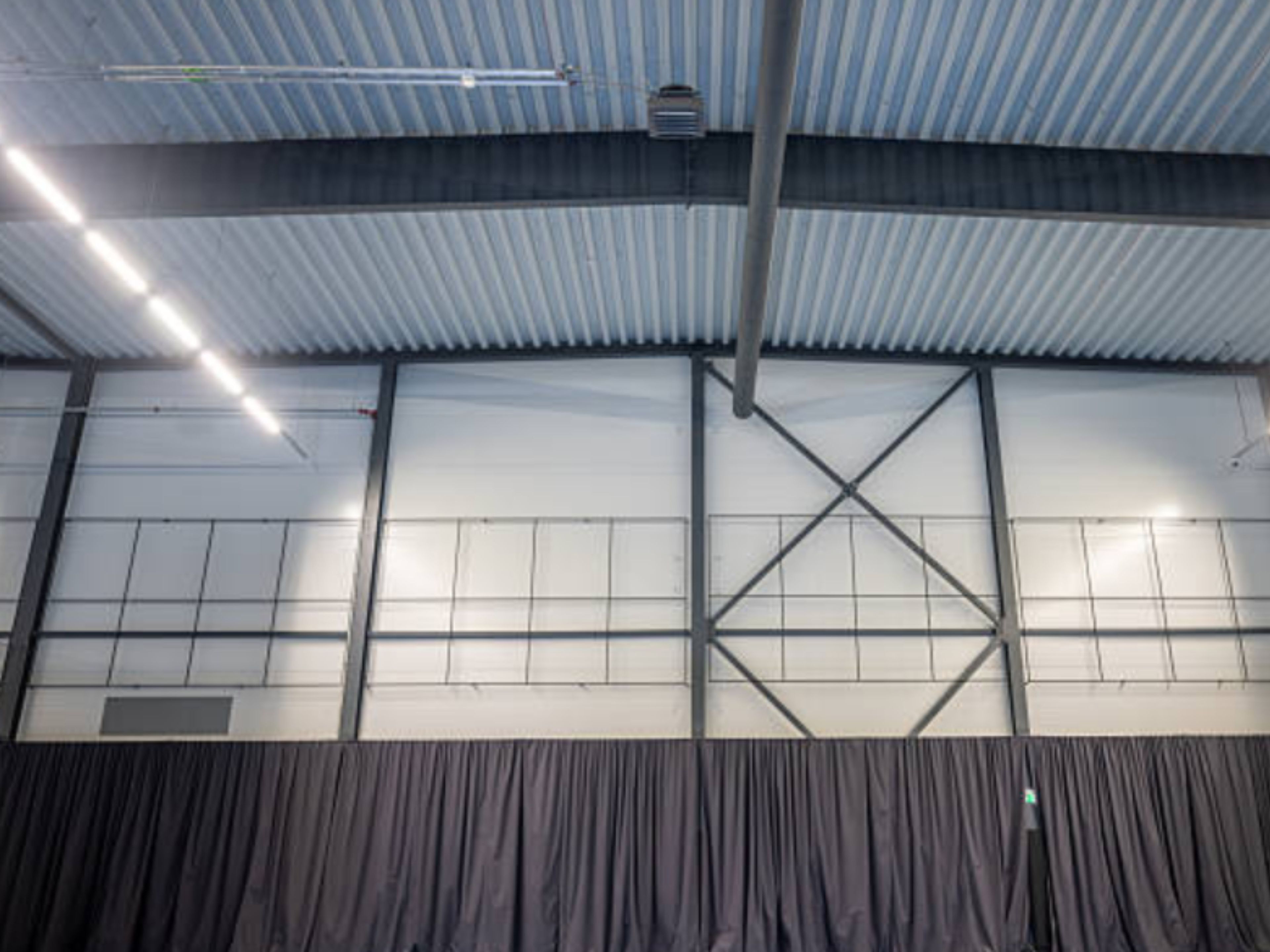
Comprehensive industrial noise control relies on complementary components that absorb, block, and isolate unwanted energy.
Acoustic Panels and Baffles
Absorptive panels line walls or hang overhead to control reflected sound. Panels rated between NRC 0.80 and 1.00 are typical for manufacturing spaces. By shortening reverberation time, they improve speech intelligibility and reduce cumulative exposure. Typical materials include mineral fiber, foam composites, or perforated metal with acoustic fill.
Sound Barriers and Curtains
When direct blocking is needed, barriers and curtains prevent line-of-sight transmission. Following the mass law, doubling surface weight increases transmission loss by roughly 6 dB. Proper sealing is essential; small gaps can significantly degrade performance (depending on frequency and gap size). Industrial barrier assemblies typically reach Sound Transmission Class (STC) 35 to 60 depending on density and joinery.
Acoustic Enclosures and Cabinets
Enclosing noisy machinery remains one of the most effective industrial noise reduction methods. Modular steel or composite enclosures combine blocking mass with internal absorption. Custom industrial enclosures can achieve STC 45 to STC 70 performance depending on wall mass and construction, while standard Commercial Acoustics assemblies typically test above STC 50 on single-stud walls. Ventilation openings require silencers or acoustic louvers to maintain airflow without sacrificing attenuation. Gasketed doors and removable panels preserve integrity while allowing maintenance access.
Duct Silencers and Attenuators
Airborne noise carried through ducts or exhaust paths can extend far from its source.
- ASTM E477 governs silencer insertion-loss testing and pressure-drop verification.
- In properly designed duct or exhaust paths, attenuation of 10–30 dB is achievable with correctly sized silencers, values typical for heavy-duty industrial systems.
- Design balance between acoustic loss and airflow resistance prevents system inefficiency.
Vibration Isolators and Damping Systems
Structure-borne noise cannot be reduced by absorption alone. Vibration isolation—using elastomeric pads, resilient channels, or spring mounts—breaks the transmission path between a machine or mechanical system and its supporting structure.
Commercial Acoustics provides consulting and product guidance for these vibration-control measures. Selection depends on load, deflection, and the ratio between excitation and isolator natural frequency. Damping materials such as viscoelastic sheets or constrained-layer composites limit resonant amplification in sheet metal or framing.
Designing an Integrated Noise and Vibration Control System
A successful plan begins with prioritization informed by measurements. Results identify which combination of absorption, barriers, or isolation yields the greatest improvement per dollar spent.
Key Steps in System Design and Integration
- Measure and map sources. Begin with baseline surveys to capture sound pressure levels and vibration signatures across operating equipment. This data reveals dominant frequencies and problem zones.
- Model the energy paths. Use boundary-element or finite-element simulations to predict how sound and vibration travel through structures. Treat it as an engineering analysis, define the source, quantify the path, and modify transmission, reflection, or radiation as needed.
- Coordinate across trades. Acoustic assemblies connect directly to HVAC, electrical, and mechanical systems. Early coordination prevents rigid couplings and maintains acoustic continuity.
- Verify mechanical isolation. Even a single rigid bolt can bypass an isolator line. Install isolators before final pipe or conduit alignment to prevent vibration bypass.
- Document installation details. Record material placement, isolation ratings, and alignment data for future maintenance or compliance validation.
Validation and Maintenance
After installation, field testing confirms whether acoustic and vibration targets are met. Readings are compared against baseline data to calculate actual decibel or amplitude reduction. Minor deficiencies, such as unsealed seams or hard connections, can often be corrected on-site.
Ongoing maintenance keeps performance stable. Absorptive surfaces require cleaning to prevent dust buildup that lowers NRC ratings. Isolators should be inspected for cracking or compression set. Documenting these checks supports audits and extends system reliability.
How Commercial Acoustics Delivers Engineered Solutions
Commercial Acoustics designs and manufactures integrated noise-control systems that combine absorption, barriers, and vibration isolation for manufacturing, commercial, and institutional environments. Each assembly gets field-tested to prove that lab data holds under plant conditions. Configurations include modular panels, barrier walls, equipment enclosures, and vibration mounts rated for heavy-duty service.
Systems are engineered to perform under demanding environmental conditions common to manufacturing and mechanical-equipment areas. Product data, STC, NRC, and insertion-loss values, follows ASTM test standards for verified performance. Technical support extends through installation and commissioning so the installed results match design expectations.
Best Practices and Common Pitfalls
- Treat both airborne and structure-borne paths; neglecting vibration allows re-radiation through floors and walls.
- Maintain seal continuity across barriers and enclosures.
- Confirm material compatibility with temperature and chemical exposure conditions.
- Balance acoustic treatment with ventilation requirements to prevent overheating or backpressure.
- Validate performance against baseline data and design intent after installation.
Industrial environments demand precise control of sound and vibration to protect personnel, equipment, and community relations. An integrated approach using absorptive panels, barriers, enclosures, silencers, and vibration isolators delivers measurable results. By applying these engineering principles, facility teams achieve sustained industrial noise control and long-term compliance with occupational and environmental standards.
Specify Commercial Acoustics Systems for Proven Industrial Noise Control
Commercial Acoustics engineers and manufactures complete noise and vibration control systems for commercial, manufacturing, and mixed-use facilities. Each product is tested for verified STC, NRC, and vibration-isolation performance under field conditions. Our modular, durable systems provide reliable performance under industrial conditions. Contact our team today for specification or design support.