
What Is An STC Rating? Sound Transmission Class Explained
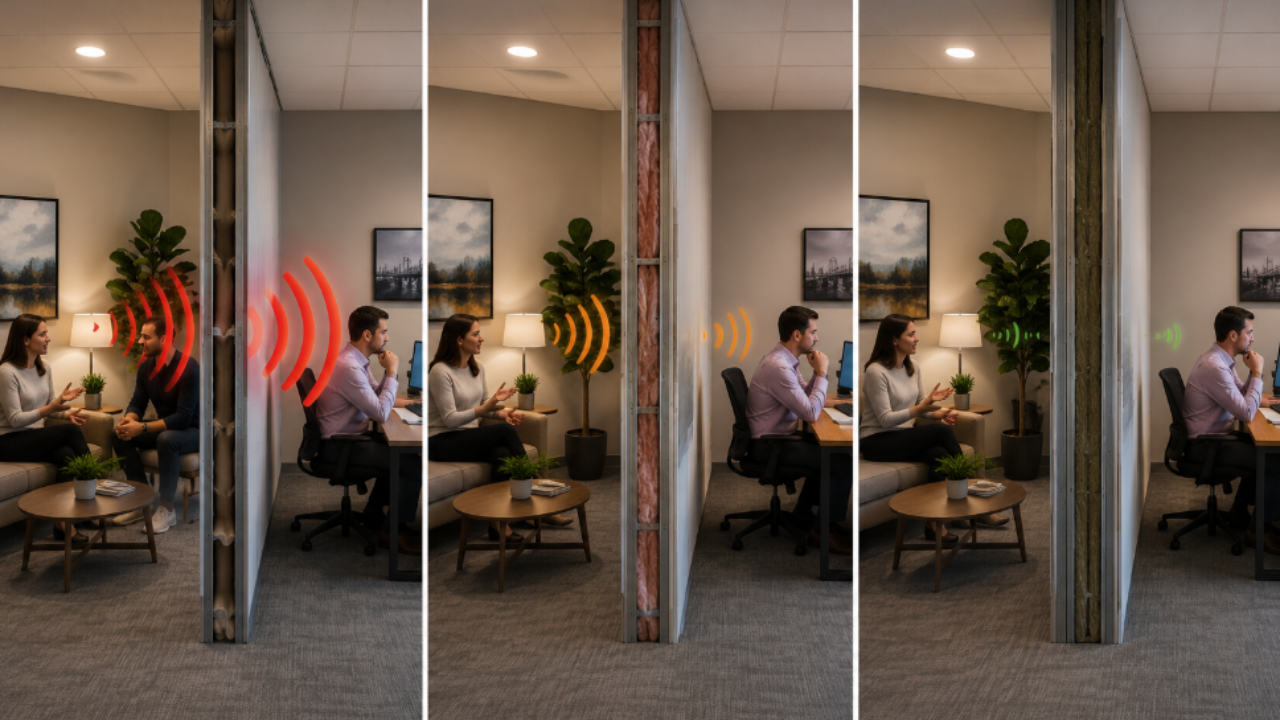
Finished walls rarely reveal how much sound they can stop. Two rooms can look identical after construction, yet one may allow speech, mechanical noise, or tenant activity to pass through weak points in the assembly. That hidden performance is what an STC rating helps project teams evaluate before they select a wall system, barrier, door, or enclosure strategy.
What An STC Rating Measures
Sound Transmission Class is a single-number measure of airborne sound isolation. Designers, contractors, and facility teams use it to compare how well an assembly limits sound transmission from one space to another. It is commonly applied to walls, partitions, doors, windows, floor-ceiling assemblies, and other separating elements.
Higher numbers generally indicate stronger airborne sound isolation. That rating carries more weight when the team knows what was tested, how the assembly was built, and where sound may still bypass the rated assembly.
Sound Blocking Versus Sound Absorption
An STC rating is easier to use correctly when the project team separates sound isolation from sound absorption. Sound blocking limits how much sound travels through a wall, floor, door, window, or barrier into the next space. Sound absorption reduces reflected sound inside the room where the noise is already present.
Acoustic panels, ceiling clouds, and baffles can make a room less echoic, but they do not automatically create strong isolation between rooms. A conference room may sound cleaner after absorptive treatment and still allow speech to move through a weak demising wall, a hollow-core door, or an unsealed ceiling path.
How STC Testing Turns Sound Loss Into One Number
STC is tied to airborne sound, including speech, office activity, television, light equipment noise, and other sound that travels through the air before striking a building assembly. In a laboratory test, the assembly separates a source room from a receiving room, and instruments measure how much sound energy passes through at different frequencies.
From Transmission Loss To A Single Rating
ASTM E90 covers laboratory measurement of airborne sound transmission loss for building partitions and elements. ASTM E413 covers the method used to calculate single-number sound insulation ratings from measured sound attenuation data.
At a basic level, the test plays sound on one side of a partition and measures what reaches the other side. The rating procedure then condenses performance across one-third-octave bands into one number, which simplifies comparison but removes frequency-specific detail. Two assemblies with similar scores can still behave differently once installed.
Sound Transmission Class Chart: What The Numbers Usually Mean
A typical STC rating chart translates lab-tested numbers into practical expectations. These ranges should be treated as general guidance because background noise, room layout, weak points, and occupant expectations can change what people actually hear.
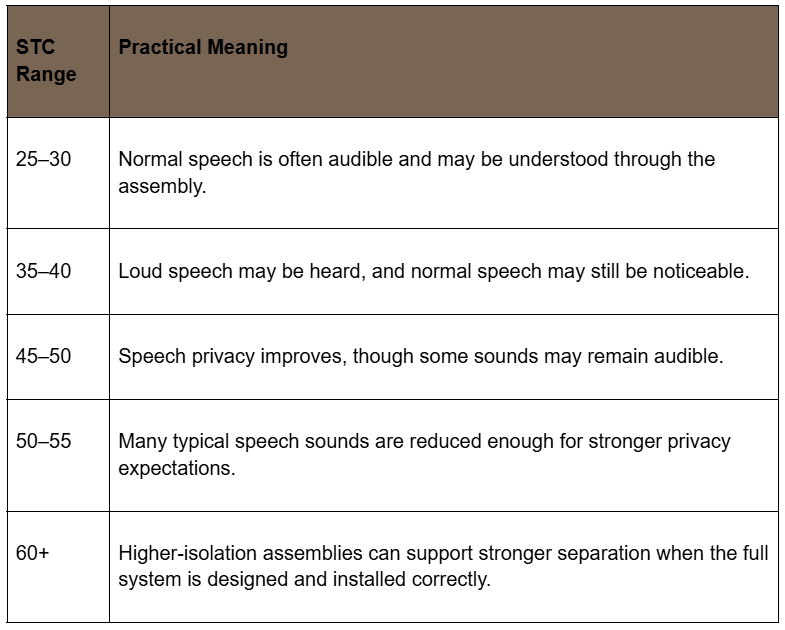
A good score depends on the space. A private office, medical consultation room, classroom, hotel guest room, mechanical room, and manufacturing area each place different demands on acoustic separation. Speech privacy usually calls for a different isolation strategy than machine rumble, and separating adjacent offices is not the same as containing a compressor, pump, fan, generator, or production line.
What Affects STC Ratings Of Materials And Assemblies
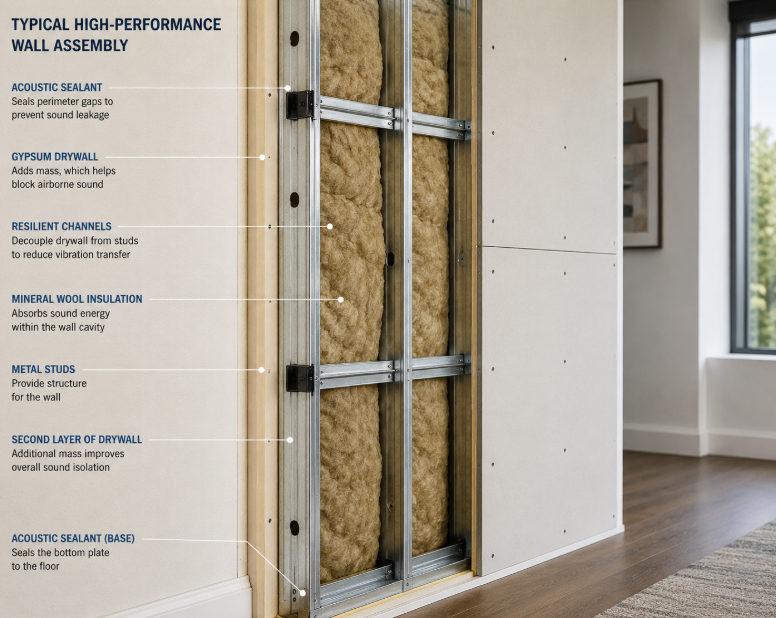
Once the target is set, a common specification mistake is treating the number as if it belongs to a single material. STC usually describes the performance of a complete assembly. STC ratings of materials are most useful when they are tied to a tested assembly because sound isolation depends on how the material works with framing, cavities, seams, openings, and adjacent components.
Final performance depends on how the wall layers work together. A dense membrane can add mass, insulation in the cavity can reduce resonance, decoupling can limit vibration transfer through framing, and properly detailed joints can keep sound from leaking through small gaps.
Weak Paths That Reduce Installed Performance
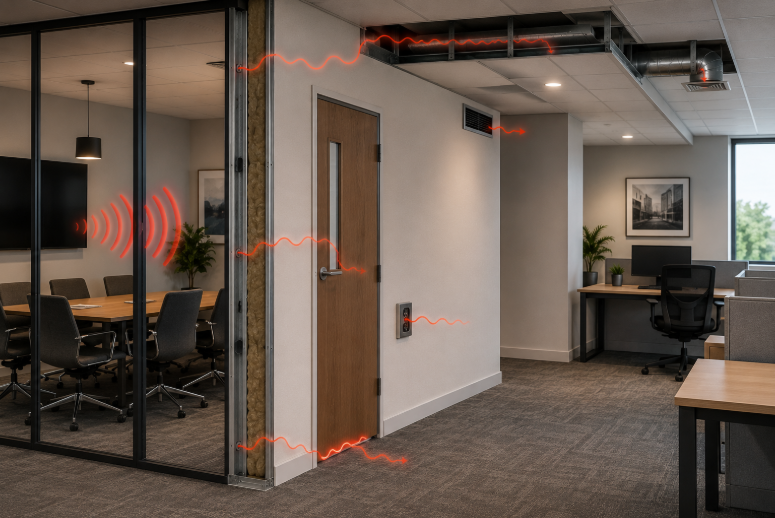
The weak point matters because sound follows available paths. A high-performing wall can be undermined by an untreated door, an unsealed electrical box, a shared ceiling plenum, a duct opening, a back-to-back outlet condition, or a gap at the floor track. In real buildings, sound may also flank around the rated assembly through ceilings, floors, side walls, structural connections, or service penetrations.
That is why installed performance can fall short of laboratory expectations even when the basic wall type appears appropriate on paper.
Why Calculating Sound Transmission Class Requires Assembly Context
Because those paths depend on how the assembly is built, calculating STC rating is not a matter of adding up product numbers. A wall with a rated membrane, a layer of drywall, and insulation does not receive a final score by simple arithmetic. The assembly has to be tested, modeled, or evaluated as a system because sound transmission is shaped by how the parts interact.
Added mass may help, but stiffness, framing connections, cavity depth, damping, workmanship, and sealing details can shift performance. A stronger assembly is usually the result of coordinated design, not a stack of unrelated sound-control products.
Where Sound Transmission Class Falls Short
Low-frequency noise is one of the biggest limitations of STC. The metric is useful for many speech-frequency concerns, but it does not fully describe performance against bass-heavy music, mechanical rumble, transportation noise, or vibration-driven equipment sound. A wall that performs well for voices may still transmit a fan tone, equipment vibration, impact energy, or bass-heavy sound.
Mechanical rooms, fitness spaces, entertainment venues, restaurants, and manufacturing areas often need source, vibration, and flanking-path review before a wall assembly is treated as the full answer.
Absorption Does Not Replace Isolation
Treating absorption as isolation can lead teams to fix room echo while the sound-transfer problem remains. Absorptive treatments can improve comfort and intelligibility inside a noisy room, but they do not usually stop sound from entering the next room. Isolation work still depends on mass, airtightness, separation, damping, and assembly control.
Why Installed Performance Depends On Details
Lab ratings become more useful when the project team also accounts for installation, existing conditions, and the timing of acoustic decisions.
Site Installation
Site installation shapes whether a high STC rating performs as expected. Laboratory tests assume controlled construction and a defined specimen. Real building conditions introduce trade sequencing, electrical and mechanical penetrations, door frames, ceiling transitions, firestopping requirements, and sometimes unknown existing conditions.
Even small gaps can matter because airborne sound does not need much space to leak. When the project goal is privacy or noise control, sealing and detailing are part of the acoustic design.
Retrofits
Retrofits make hidden sound paths harder to confirm. Existing walls may have unknown stud conditions, back-to-back outlets, open top tracks, or penetrations hidden above ceiling tile. A retrofit plan that focuses only on surface material may miss the real path.
Existing-condition review helps determine whether the project needs added mass, cavity treatment, decoupling, door upgrades, ceiling-path control, equipment isolation, or a more complete enclosure strategy.
New Construction
New construction gives teams a cleaner planning window. Target ratings can guide partition schedules, wall types, door selections, glazing choices, and details around penetrations. The earlier the acoustic goal is tied to the assembly, the easier it is to avoid conflicts between sound isolation, fire rating, cost, constructability, and service access.
How Commercial Acoustic Planning Uses The Rating
The right STC rating gives project teams a starting point for comparison, but specification still has to account for the sound source, receiving space, assembly design, bypass routes, and privacy goal. That keeps the rating in its proper role as a useful measurement for airborne sound isolation. It also helps teams decide when the project needs source testing, flanking-path review, or a more complete isolation strategy.
Work With Commercial Acoustics To Match Sound Control To Real Building Conditions
Commercial Acoustics can help evaluate the source, pathway, assembly, and receiving space before a sound-control plan is selected. Depending on the sound path, the plan may combine blocking materials, barriers, enclosure planning, absorptive treatment, sound masking, or consulting support. Contact us today for more information.
Sound Transmission Class FAQs
What Does STC Measure?
STC measures how well a wall, floor-ceiling assembly, door, window, or barrier limits airborne sound transmission between spaces.
What Is A Good STC Score For Commercial Spaces?
A good score depends on the noise source, receiving space, and privacy expectation, so offices, medical rooms, classrooms, mechanical spaces, and tenant separations may require different isolation levels.
Does STC Measure Low-Frequency Noise?
STC does not fully describe low-frequency noise such as bass-heavy music, mechanical rumble, or vibration-driven equipment sound.
Can Acoustic Panels Improve Sound Isolation Between Rooms?
Acoustic panels can reduce echo inside a room, but sound isolation depends more on mass, airtightness, separation, damping, and assembly detailing.
Why Can A High-STC Wall Still Leak Sound?
A high-performing wall can still leak sound when gaps, doors, penetrations, ceiling paths, ducts, or connected structures bypass the rated assembly.