
Designing for Silence: Strategic Noise Mitigation for Rooftop AHUs in Data Center Facilities
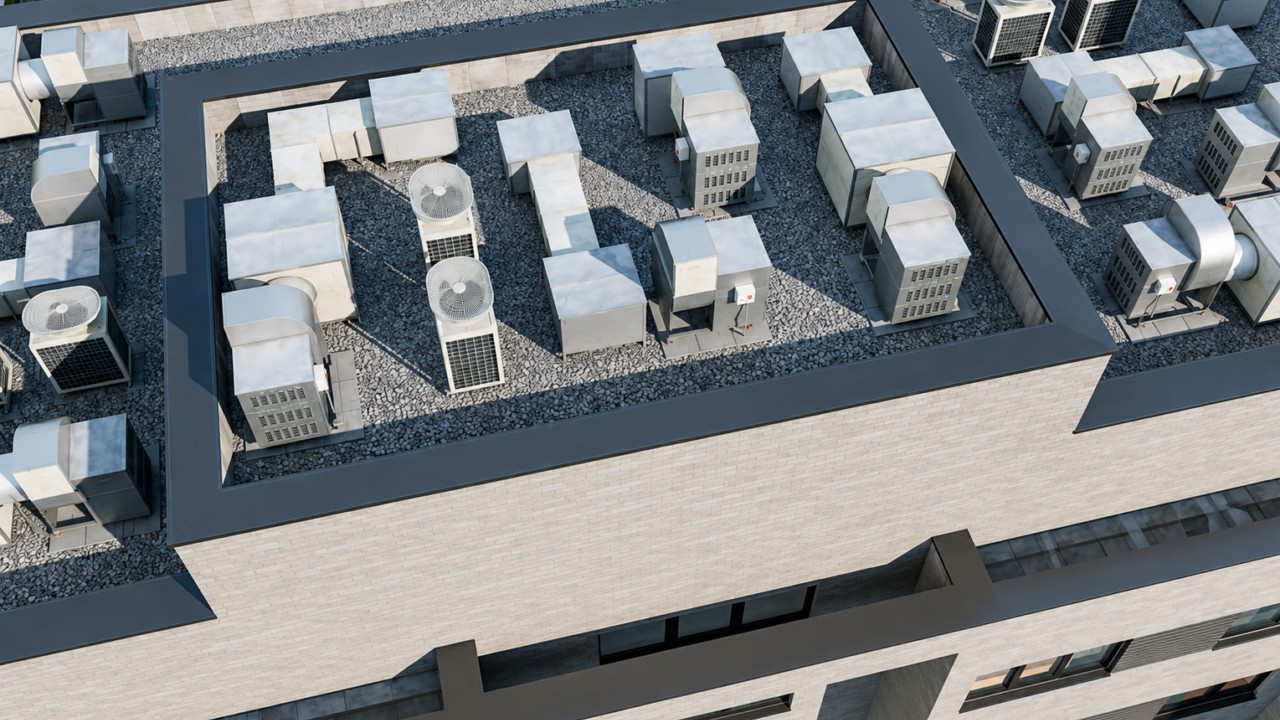
Data centers demand consistent power, precision airflow, and secure environments. As rooftop equipment expands to meet these requirements, unintended consequences surface. Rooftop AHU noise mitigation must now be engineered as an operational priority.
Primary Mitigation Strategies
Noise originating from the fan system remains the first and most direct threat to acoustic compliance. Addressing tonal and broadband emissions at their source provides the most effective path to long-term mitigation.
Mechanical fans—especially axial models paired with high-volume discharge—create a distinct tonal signature. These tones propagate more efficiently than broadband mechanical noise and can carry across structural decks, open rooftops, and neighboring facilities. Variable-frequency drives (VFDs), while efficient, often introduce low-frequency pulses that intensify these challenges.
Each rooftop AHU system produces unique acoustic challenges based on its configuration and environment. The table below outlines the primary noise paths engineers should evaluate, along with appropriate mitigation methods and verification strategies.

Silencers help manage this noise without impeding airflow. Their design must account for fan type, static pressure, and airflow velocity. Placement at both intake and discharge points is often required to contain direct sound propagation.
Similarly, acoustical louvers—often undervalued—offer dual performance by managing airflow direction and absorbing direct radiated noise. Their internal baffles disrupt line-of-sight sound travel and reduce the need for additional duct-based treatments when integrated early in the design.
Equipment Enclosure and Flanking Control
Once primary fan emissions are addressed, remaining sound paths must be contained through structural barriers and isolation systems that limit radiation and bypass.
- Modular acoustic enclosures form the first layer of rooftop radiation control.
- These systems surround AHUs to block free-field propagation.
- Panels must withstand UV exposure, wind uplift, and thermal cycling, while maintaining access for routine service.
- Material selection cannot prioritize one performance factor at the expense of another.
Assemblies must balance acoustic absorption, structural loading limits, fire compliance, and moisture resistance. Lightweight systems simplify installation, but high-mass options are often required for meaningful low-frequency suppression.
Low-Frequency Challenges Require Material Strategy
Tonal frequencies below 125 Hz often escape standard silencers and enclosures. These sound waves travel farther, reflect persistently, and resonate inside structural cavities such as ceiling plenums and metal roof decks. Effective mitigation requires materials with higher surface density, tuned dampers, and placement strategies that disrupt direct transmission lines.
Traditional wall assemblies are typically optimized for mid- to high-frequency attenuation. To address low-end energy, designers must introduce additional mass or layered systems that target these specific bands. In high-sensitivity sites, treatment may extend to adjacent support structures that can act as secondary radiators.
Flanking Transmission Demands Preemptive Design
Airborne sound is only part of the problem. Structure-borne vibration creates flanking paths through framing, mechanical mounts, and roof penetrations. These paths often transmit energy even after airborne mitigation appears successful. Resilient curb designs, spring isolators, and vibration-rated anchors must be selected based on substrate type and expected load transfer.
- Sealing roof penetrations with acoustically rated materials is essential.
- Flashing and sealing tapes that are waterproof but not resilient may create bridges for vibration transfer. Duct design also plays a role.
- Long, straight runs can amplify sound, while elbows and diffusers—when correctly configured—can scatter or dissipate energy.
- Expansion joints at critical locations reduce mechanical echo through rigid ductwork.
Site-Wide Protection with Barrier Systems

In multi-rooftop campuses and urban deployments, rooftop AHU noise can extend beyond the mechanical zone. When reflection off walls or neighboring buildings occurs, perimeter defenses are required to contain the acoustic footprint.
Mass and Absorption Work Together
Sound barrier walls serve as both physical dividers and acoustic performance layers. Effective systems pair dense core materials with absorptive outer layers. This combination allows the barrier to block low-frequency propagation while also minimizing reflection that could rebound toward sensitive zones.
To perform correctly, wall height must exceed the line-of-sight between the noise source and nearby receptors. In retrofit applications, barriers are often added after complaint or permit delay. Incorporating these systems in initial design reduces cost and improves visual integration with rooftop equipment screens or parapet structures.
Internal Performance and Lifecycle Oversight
Rooftop AHU noise isn’t only an exterior issue. Interior acoustic impact can interfere with staff, monitoring systems, and mission-critical equipment—particularly when sound migrates into adjacent corridors or work zones.
Interior Sound Control Affects More Than Comfort
Absorptive panels help prevent internal reverberation and reduce tonal bleed from structural surfaces. In data centers, even low-amplitude hums can trigger environmental alarms or affect sensor accuracy. Over time, vibration may also contribute to misaligned fans, loose fasteners, or maintenance callouts—issues that compromise uptime and increase total system cost.
Noise control must also align with broader certification and performance frameworks.
- ASHRAE sets background noise thresholds for mission-critical facilities.
- WELL Building and LEED certifications now include acoustic benchmarks, particularly in hybrid or mixed-use data center environments.
Rooftop AHU noise mitigation directly supports these goals and reduces the need for late-stage design changes that threaten certification status.
Post-Install Testing Validates Acoustic Integrity
Once installed, systems must be tested under full mechanical load. Acoustic commissioning involves mapping dBA levels across rooftop zones, structural boundaries, and internal plenum locations. These tests confirm that mitigation systems are functioning as intended and identify any flanking paths or panel weaknesses.
Ongoing monitoring can detect changes in performance over time due to equipment wear, seasonal expansion, or vibration creep. Facilities that include long-term acoustic verification avoid compliance drift and maintain stakeholder confidence.
Design Rooftop Systems That Perform Quietly, Decades Into Operation
Noise mitigation isn’t a retrofit issue — it’s a systems-level decision made early in design. Commercial Acoustics partners with engineering teams to plan and implement rooftop AHU noise control strategies that hold up under real-world conditions. If you're evaluating acoustic design options for a current or upcoming facility, we’d be glad to schedule a conversation.