
Industrial Silencers: How They Reduce Noise in Industrial Air Systems

Every industrial facility operates under constant acoustic and mechanical stress. Industrial silencers reduce noise generated by fans, blowers, and exhaust systems without restricting airflow or equipment performance. Designed for demanding environments, these assemblies help facilities meet noise-control requirements, protect workers, and maintain reliable operation across critical processes.
What Industrial Silencers Are and Why They Matter
Industrial facilities combine concentrated power and airflow in structures that easily transmit noise. OSHA’s 85 dBA exposure threshold and most municipal ordinances make it clear, control the noise at its source or risk penalties and long-term hearing loss among employees.
Industrial silencers, sometimes called mufflers or sound attenuators, intercept acoustic energy before it spreads through ductwork or stack outlets. By cutting sound where it starts, they protect crews, reduce vibration fatigue, and extend equipment life. In typical fan or blower systems, properly tuned silencers can provide substantial noise reduction depending on frequency and flow, a measurable difference that often determines whether a plant stays compliant or faces costly mitigation later.
How Industrial Silencers Work
Industrial noise rarely behaves predictably. Low-frequency pulses from axial fans travel through framing, while higher-frequency hiss from valves dissipates quickly. Matching each silencer to the dominant frequency and airflow conditions of its source is what separates a quiet system from a noisy one.
Silencers reduce noise through three acoustic mechanisms, absorptive, reactive, and hybrid, each suited to a specific frequency range and operating condition.
Absorptive Silencers
These rely on mineral-fiber acoustic fill behind perforated metal facings. As air passes, sound energy converts into a trace of heat, damping mid- and high-frequency turbulence. They perform well where airflow velocity and temperature remain within normal HVAC or process limits.
Reactive Silencers
Reactive models use tuned chambers and baffles that reflect or cancel low-frequency pressure waves such as fan blade-pass tones or compressor pulses. Geometry drives performance: small changes in chamber length or cross-section shift target frequencies.
Combination Silencers
Hybrid units merge both designs to deliver broadband control in systems with mixed noise spectra. They are common in mechanical rooms and multi-source exhaust networks.
Performance is quantifiable. Insertion loss, the decibel difference between untreated and treated flow, is measured under standardized laboratory conditions used across the industry for attenuation documentation.
Integration of Silencers in Air Systems
Industrial silencers perform best when integrated where turbulence and pressure changes are highest. Inlet silencers are positioned upstream of fans or blowers to reduce tonal noise at its source, while discharge silencers sit at duct or stack outlets to limit radiated sound to the environment. Duct-mounted models are often used in plenum or rooftop exhaust applications to minimize transmission through the building envelope.
Placement depends on available static pressure and maintenance access. Installing silencers in straight duct runs helps preserve laminar flow and prevents flow separation that can raise system resistance. Where airflow temperatures vary, expansion joints or flexible connectors are added to maintain seal integrity. Correct placement within the air path ensures attenuation performance without compromising system efficiency.
Types of Industrial Silencers and Applications
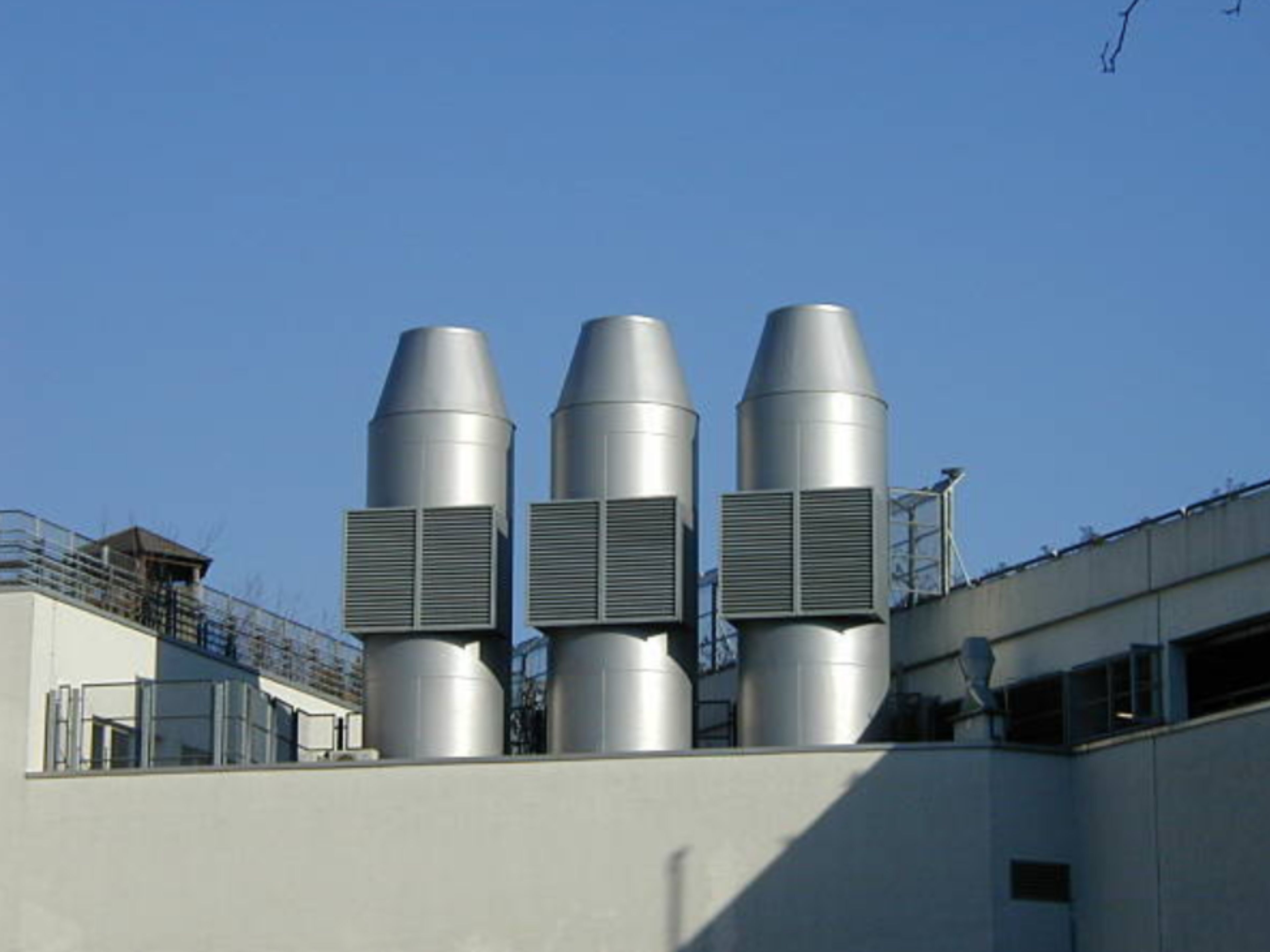
Silencers are selected according to the noise source, airflow characteristics, and installation environment.
Industrial Fan Silencers
Fan assemblies use inlet and discharge silencers to reduce blade-pass and turbulence noise without increasing pressure drop. Outdoor models often include drainable housings and weather hoods to keep moisture away from the acoustic fill.
Compressor and Blower Silencers
These control tonal and pulsation noise. Reactive chambers target fundamental tones, while absorptive liners handle harmonics. Units fabricated from galvanized, aluminum, or stainless steel with oil-resistant linings maintain durability in hot, moisture-laden air.
Exhaust and Vent Silencers
High-temperature, high-velocity gases from generators, turbines, and steam vents demand heavy-duty construction. Expansion chambers and perforated diffusers dissipate pressure surges before discharge.
Industry Use Cases
- Power generation: Turbine and generator exhausts rely on high-temperature silencers to meet site noise limits.
- Manufacturing: Compressor and process-exhaust silencers improve safety and reduce fatigue.
- Chemical processing: Corrosion-resistant designs protect against acidic or humid vapors.
- Oil and gas: Drilling and gas-compression sites require rugged housings and replaceable fill.
- Transportation and heavy equipment: Engine-exhaust silencers maintain performance under vibration and continuous duty.
Design and Selection Considerations
Specifying an industrial silencer is a balance between acoustic attenuation and system efficiency. Each design factor contributes to that trade-off.
Acoustic Performance
Determine the target insertion loss by frequency band. Reactive designs handle lows (< 250 Hz); absorptive types address highs (> 500 Hz); hybrids cover both.
Airflow and Pressure Drop
Engineers typically aim for total pressure losses below 1 in WG. Still, certain high-pressure or compact installations may tolerate slightly higher values if attenuation goals require it.
Materials and Durability
Industrial silencers are typically fabricated in galvanized, aluminum, or stainless steel, the same durable metals used in Commercial Acoustics’ other sound-control systems. Acoustic fill is enclosed behind perforated or film-faced barriers for fiber containment.
Maintenance and Accessibility
Dusty or particulate-laden systems benefit from clean-outs or removable panels for periodic inspection. Designs that maintain laminar flow minimize debris accumulation and extend service life.
Compliance and Documentation
Silencers should carry published acoustic and aerodynamic data derived from recognized laboratory testing. Commercial Acoustics provides documentation and design submittals to support engineering review and specification.
Installation and Maintenance Practices

Proper installation determines whether a silencer delivers its rated performance over time. Mounting flanges must be aligned squarely to prevent leaks and vibration, and all seams should be sealed with acoustically rated gaskets or caulk. Support framing or hangers should isolate vibration and prevent stress on duct connections.
Maintenance schedules typically align with facility inspection intervals. Accumulated dust or oil film reduces absorption efficiency, so periodic cleaning or vacuuming of accessible surfaces is recommended. In harsh or particulate environments, removable panels or clean-out ports simplify maintenance without dismantling ductwork. These practices help sustain consistent noise control and extend the service life of the equipment.
Industry Growth and Regulation
According to industry research, the global industrial-silencer market is projected to approach USD 2.8 billion by 2033, driven by stricter noise-exposure limits and increased manufacturing output. Power generation, petrochemical processing, and logistics facilities remain major adopters. These sectors demand silencers that combine acoustic performance with reliability under high-temperature and corrosive conditions.
As local ordinances tighten and ESG reporting gains traction, engineered noise-control products have become part of broader environmental compliance strategies. Facilities that invest in verified acoustic testing reduce community noise exposure and avoid retrofits later in the asset life cycle.
Future Trends in Industrial Noise Control
New developments center on smarter, more maintainable silencer designs. Manufacturers are exploring modular units that allow easier media replacement and integration of temperature or pressure sensors for performance tracking. Hybrid models combining reactive chambers with advanced acoustic absorbers are improving broadband attenuation in smaller footprints.
Across the noise-control industry, design teams continue to refine silencer geometry and materials to support evolving energy-efficiency standards and long-term durability. These innovations keep facilities compliant while reducing maintenance over time.
Partner with Commercial Acoustics
Commercial Acoustics provides engineered noise-control systems for fan, blower, and exhaust applications. Each solution is supported by acoustic modeling, fabrication expertise, and documentation for dependable compliance and quieter operation. Contact us today for more information.