
10 Proven Ways to Make a Generator Quieter Without Compromising Performance

Generator noise can exceed 85 decibels at close range—loud enough to disrupt classrooms, trigger zoning violations, or draw complaints from nearby buildings. Facility managers and site planners need clear strategies to reduce that exposure. Knowing how to quiet a generator protects both performance and compliance from the start.
1. Identify the Full Noise Path, Not Just the Source
Generators emit noise from multiple sources: the engine block, cooling fan, air intake, and exhaust system. Vibration also moves through mounting platforms, transferring structure-borne noise into nearby surfaces. Understanding how to quiet a generator begins with isolating each of these transmission paths and treating them individually using engineered acoustic methods.
2. Increase Distance to Reduce Sound Energy
Distance remains one of the simplest ways to reduce noise exposure. Sound pressure drops by roughly 6 decibels every time the distance from the generator doubles. For example, placing a unit 40 feet from an occupied space instead of 10 feet can reduce perceived loudness by more than 75%. This benefit depends on clear sightlines—obstructions or hard surfaces can reflect sound back toward the listener.
3. Orient Exhaust and Intakes for Minimum Reflection
Correct exhaust direction and intake placement significantly affect noise levels.
Avoid Reflective Surfaces That Redirect Noise
Concrete walls, pavement, and metal panels reflect high-frequency sound. Positioning the exhaust away from these surfaces prevents reverberation that can amplify generator noise in tight courtyards or near service corridors.
Use Directional Exhaust Deflectors
Curved exhaust pipes or elbows can redirect engine noise upward or toward absorptive surfaces like landscaped berms or fencing. These small mechanical changes often yield 6–10 dB of reduction without requiring structural changes.
4. Reduce Mechanical Vibration at the Mounting Point
Generators mounted on rigid pads or steel frames transmit low-frequency vibration into nearby structures.
Install Isolation Mounts to Block Vibration Transfer
Elastomeric pads or spring isolators can interrupt this vibration path. When sized correctly for the generator’s weight and operating frequency, isolators have been shown to reduce structure-borne transmission by 10 to 18 decibels.
Select Mounts Based on Load and Frequency
Spring systems must be tuned to the generator’s dominant vibration range—typically between 20 and 80 Hz. Undersized or mismatched isolators may amplify resonance instead of dampening it.
5. Shield Airborne Noise with Treated Acoustic Barriers
Outdoor generators often operate near walls, alleyways, or rooftops where sound reflects into occupied zones.
Use Panels with High NRC Ratings
Sound barrier panels constructed with mineral wool, perforated steel, or foam cores typically carry Noise Reduction Coefficients (NRC) of 0.85 or higher. These materials absorb mid- and high-frequency sound while resisting weather and UV degradation.
Design for Ventilation and Moisture Resistance
Barriers must preserve airflow to avoid overheating. Open-backed designs with built-in vents allow air to pass while capturing reflected sound energy.
6. Enclose the Generator in a Purpose-Built Sound Attenuation System
Specifying how to quiet a generator during design ensures acoustic goals are met without reducing reliability. Purpose-built generator enclosures offer one of the most effective ways to achieve this.
Don’t Rely on Improvised Covers
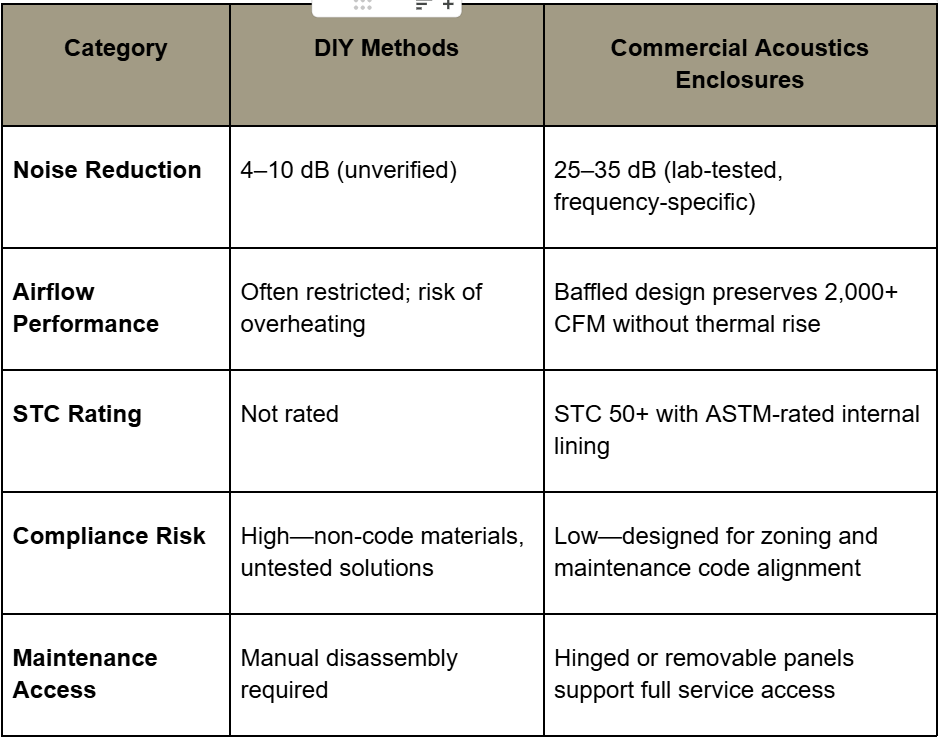
Homemade enclosures made from plywood or metal sheeting rarely offer sufficient airflow or verified noise control. These DIY options can create backpressure, heat buildup, or code violations—while typically reducing noise by only 4–6 dB.
Choose Enclosures with Verified Decibel Reduction
Commercial enclosures are engineered to reduce generator noise by 20 to 35 decibels across key frequency bands. Many models integrate baffled inlets, exhaust silencers, and ASTM E90-rated internal insulation. Compared to mufflers or plywood baffles, these systems offer consistent and measurable performance backed by field data.
7. Match Internal Treatments to Specific Noise Sources
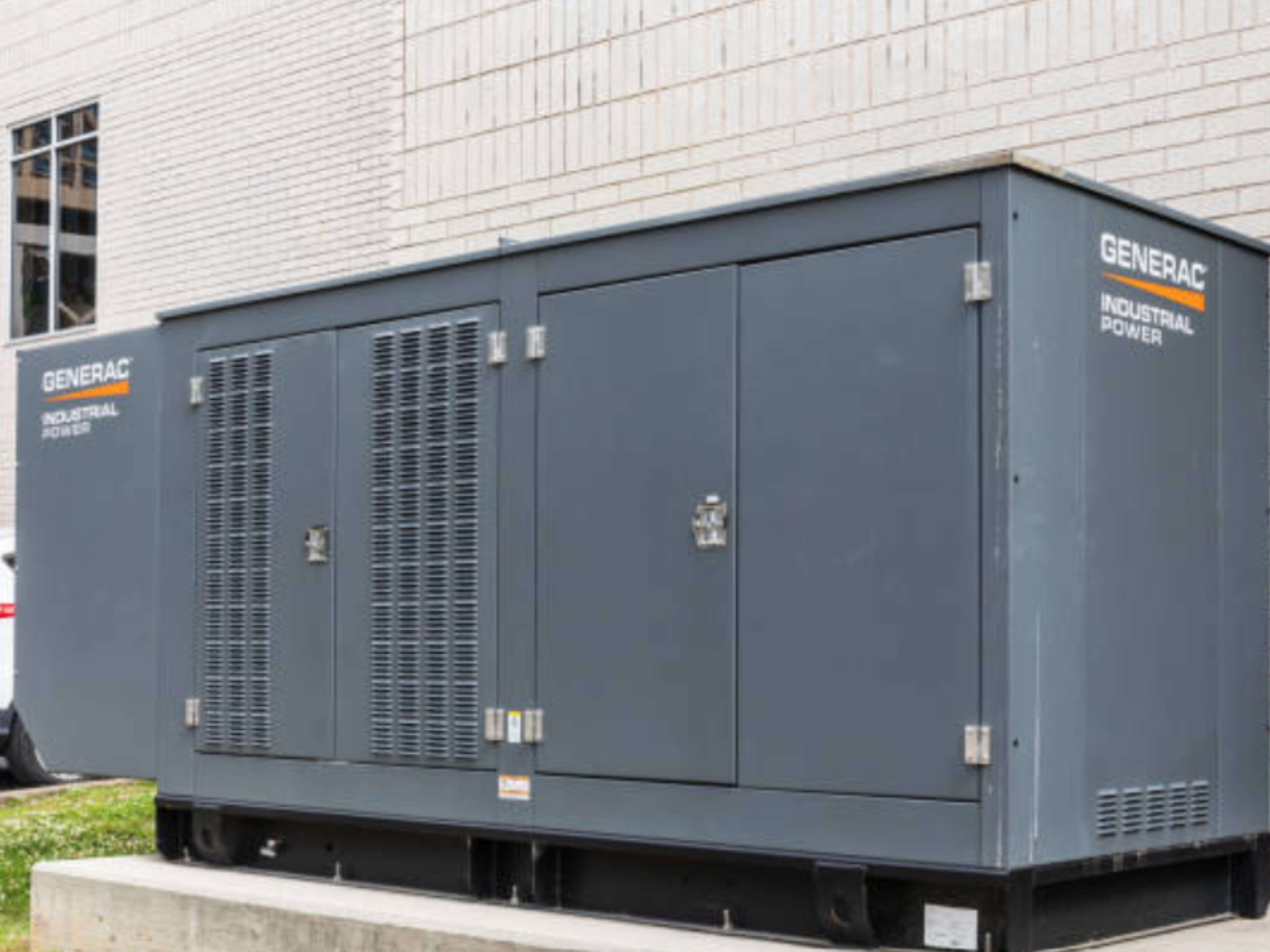
Each component of a generator emits noise differently. Engine block vibrations, exhaust discharge, and fan intake turbulence must be treated with purpose-built materials.
Apply ASTM-Rated Absorptive Lining
High-density fiberglass or mineral fiber insulation tested to ASTM E90 standards blocks engine vibration and airborne noise. These materials can reduce internal reflections by 10–20 dB, depending on surface coverage and frequency range.
Use Exhaust Silencers with Measured Insertion Loss
Baffled silencers rated by insertion loss provide targeted attenuation—typically reducing generator exhaust noise by 20–25 decibels in the 500–2,000 Hz range. These silencers maintain airflow while breaking up pressure wave harmonics.
8. Plan for Compliance in Sensitive Applications
Many generator installations occur in healthcare, education, or municipal settings where noise limits are strict.
Factor in Local Sound Ordinances and Proximity Risks
A clinic operating near a residential boundary may face 45 dB day-night average sound limits. Without an enclosure, most generators emit between 70 and 90 dB at 23 feet. Enclosures rated for 30 dB attenuation can close this gap and avoid costly fines or community complaints.
Account for Testing Cycles and Maintenance Conditions
Generators aren’t just loud during emergencies. Weekly testing, load-bank cycling, and fuel delivery create repeated sound events. Planning how to quiet a generator includes addressing these routine noise exposures to maintain long-term compliance.
Facility teams responsible for rooftop or exterior installs should document how to quiet a generator as part of their site-specific commissioning checklist.
9. Measured Noise Reduction with Engineered Enclosure Systems
Generator enclosures are most effective when their acoustic performance is supported by quantified data and field-tested system design.
Decibel Reduction and STC Data by System Type
Commercial-grade generator enclosures offer verified acoustic performance across multiple transmission paths. Models constructed with baffled airflow channels, integrated silencers, and ASTM-rated internal lining achieve total noise reductions of 25 to 35 decibels, depending on frequency distribution and site layout. These reductions are measured at standard distances from the enclosure perimeter, with results published as insertion loss or STC ratings.
In typical configurations, enclosures with 4-inch mineral fiber lining and a 25 dB-rated silencer can reduce broadband generator noise from 80–90 dB to below 55 dB at the building line. Compared to improvised baffles or deflectors, these systems deliver repeatable acoustic attenuation that aligns with municipal sound limits and zoning requirements.
Airflow Modeling and Service Access in Acoustic Designs
Internal baffling preserves airflow—often exceeding 2,000 CFM—without causing pressure imbalance or thermal rise.
- Air inlet and exhaust paths are engineered to maintain fan efficiency while suppressing tonal peaks in the 500–2,000 Hz range.
- This airflow continuity is critical for performance during full-load cycles and weekly generator testing.
Enclosure systems are also built for access. Removable panels and hinged doors allow for oil checks, load-bank wiring, and filter inspection without dismantling the unit. When installed with vibration-isolated skids and STC-rated barrier panels, the entire enclosure acts as a continuous acoustic barrier. This reduces community complaints, helps sites meet environmental noise criteria, and protects generator performance across long operating cycles.
DIY vs. Commercial Generator Noise Control
10. Coordinate Acoustic Planning with System Design
Understanding how to quiet a generator during the early stages of project design prevents retrofits later. Enclosure systems must integrate with cooling loads, fuel piping, rooftop layout, grounding, and service access.
Work Across Trades and Timing Windows
Acoustic enclosures are best installed during generator placement. Installing barriers after electrical and fuel systems are set can introduce clearance conflicts and labor inefficiencies.
Design a Quieter Installation with Commercial Acoustics Generator Enclosures
Facility managers need more than a temporary fix when it comes to generator sound. Projects that plan for long-term acoustic compliance avoid rework and reduce operational risk.
We build generator enclosures with proven STC-rated panels, airflow-controlled exhausts, and field-tested silencers that integrate cleanly into any install. Our systems have delivered 25–35 dB reductions for healthcare, education, and municipal applications. Contact us today for more information.