
6 Airport Noise Reduction Strategies for Ground-Side Operations

Most airport noise coverage starts in the air. Flight paths, descent procedures, and aircraft certification matter, but those issues largely sit with the FAA, airlines, and airport authorities. Facility teams have a different job: ground run-ups, mechanical plants, apron equipment, terminals, and other controllable sources make airport noise reduction a facilities and acoustics problem that starts with identifying the source, tracing the path, and specifying the treatment that fits.
Which Airport Noise Reduction Strategies Match Each Source?
The right strategy depends on the source, the path sound takes, and the receiver that experiences it. In acoustics, the receiver is the person or location where the sound level or its effects are evaluated. Airport ground noise can come from several distinct sources, and each calls for a different control strategy.
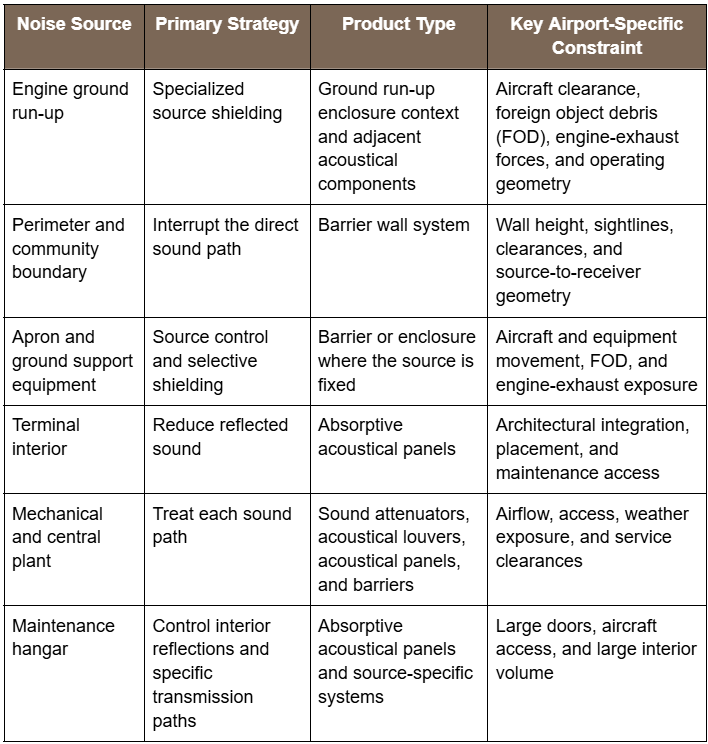
Airports are chiefly responsible for many ground-noise and facility-side measures, aircraft operators make certain operational decisions, and the FAA governs federal aviation functions that include airspace and flight procedures. This guide stays with the physical ground-side conditions a facility team can evaluate, specify, retrofit, or build around, beginning with a stationary high-power source whose location and receiver relationship can often be clearly identified.
Why Are Maintenance Run-Ups Such a Difficult Ground-Side Noise Source?
Maintenance run-ups create a concentrated noise problem because the aircraft remains stationary during high-power engine testing. A ground run-up enclosure, or GRE, is a purpose-built acoustical structure around a designated aircraft engine-test position and is sometimes referred to as a hush house in airport-noise documentation. It reduces sound from maintenance testing by controlling the path between the engines and surrounding receivers.
That operating pattern differs from a brief aircraft movement. A high-power source may remain in one position for several minutes, and maintenance schedules can place some tests during noise-sensitive nighttime periods. The combination of power, duration, and repeated exposure toward the same surrounding receivers can make run-ups especially intrusive during those periods.
What Airport Constraints Shape a Ground Run-Up Enclosure?

GRE geometry has to accommodate the aircraft and direct acoustical treatment toward the receivers that need protection. Engine airflow and exhaust requirements also affect how much of the source can physically be enclosed or shielded.
- FOD: Foreign object debris can damage aircraft or equipment, so materials and components near active operations cannot create loose-object hazards.
- Jet blast: Jet blast is the high-velocity exhaust flow behind an operating jet engine, and it can affect component placement and structural design.
- Clearance and access: Aircraft movement, maintenance access, and required operating clearances have to remain workable.
- Weather and structural exposure: Exterior components have to be designed for the environmental and structural conditions at the specific installation.
A GRE controls engine testing conducted within the geometry it was designed to address; it does not reduce departure, arrival, or overflight noise. GREs are specialized airport structures, and the products discussed here apply to adjacent ground-side noise-control applications rather than representing a complete GRE offering. For many other stationary sources, the engineering question becomes whether a simpler barrier can interrupt enough of the direct sound path to produce a useful result.
When Does an Airport Noise Barrier Actually Help?
A noise barrier helps when it forces sound to travel over or around the wall instead of directly from source to receiver. Line of sight is the unobstructed direct path between a noise source and the receiver. Breaking that path is one of the basic conditions a useful barrier must satisfy.
Sound can still travel around an obstruction. Diffraction is the bending of sound as it passes over or around the edge of a barrier, so wall height and length determine how much the sound path is changed.
How Much Reduction Can a Noise Barrier Provide?
Insertion loss is the difference in sound level at the same receiver before and after a barrier or other treatment is added under comparable source conditions. There is no universal reduction figure for an airport barrier.
Under the relevant FAA Airport Improvement Program (AIP) rules for qualifying Part 150 noise-compatibility projects, an eligible on-airport barrier must provide at least a 5-decibel (dB) reduction at the qualifying protected land use. Actual insertion loss still depends on source height, receiver position, the frequencies produced by the source, barrier geometry, openings, and surrounding conditions. A taller wall is not automatically a better wall if its location still leaves the important source-to-receiver path exposed.
Where Barrier Walls Work And Where They Do Not
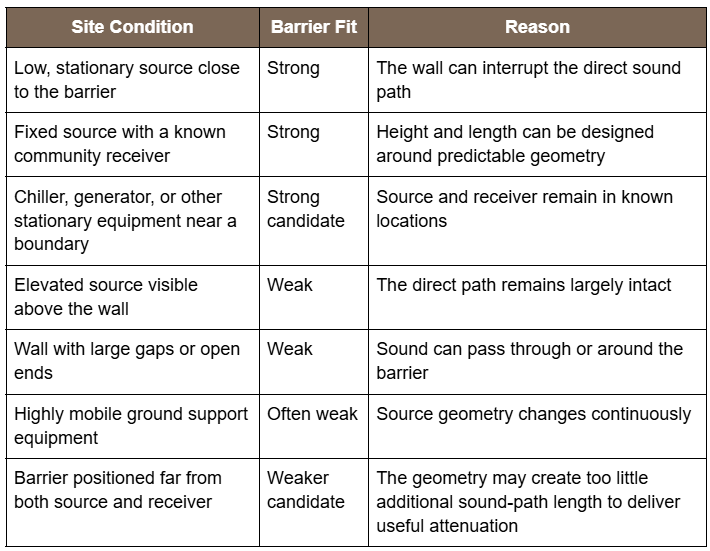
Properly located barrier wall systems can be appropriate for stationary outdoor equipment and other predictable perimeter sources. A poorly positioned wall can consume significant project budget without delivering the expected airport noise reduction.
Airport conditions can also rule out an acoustically attractive location. Exterior walls cannot interfere with required aircraft clearances or critical sightlines. Barrier height and placement also have to be checked against applicable FAA obstruction-review requirements before construction, including Part 77 notice requirements where they apply. Wind, weather, maintenance access, and nearby jet-blast conditions can further influence the structure and placement.
How Should Apron and Ground Support Equipment Noise Be Controlled?
Apron noise changes the problem because many sources move throughout the operating area. Ground support equipment, or GSE, is the collection of vehicles and machines used to service aircraft on the ground. Tugs, baggage equipment, service vehicles, and other machines can create intermittent noise from locations that shift throughout the day.
Auxiliary power units also deserve attention. An auxiliary power unit, or APU, is an onboard system that supplies power to an aircraft when the main engines are not providing it. At a gate or service position, that source may remain in a predictable location long enough for shielding or other source-control measures to become practical.
When Does Fixed Shielding Make Sense on an Apron?
A permanent barrier can make sense around a fixed or consistently positioned source when the geometry supports it. A moving tug changes its relationship to both the barrier and receiver every time it crosses the apron, which makes permanent shielding much less predictable.
Belt loaders create a similar issue because they are repeatedly repositioned as aircraft come and go. Where equipment operates in a consistent service position, barrier wall systems may still be evaluated when aircraft movement, clearances, FOD risk, sightlines, and source-to-receiver geometry allow. Highly mobile sources may be better addressed at the equipment or operational level because a barrier that interferes with aircraft or vehicle movement is not a workable solution.
Why Does Terminal Reverberation Reduce Speech Intelligibility?
Inside a terminal, the acoustic problem can shift from sound traveling across the site to sound remaining in the room through repeated reflections. Reverberation is the persistence of sound in a space after the source occurs because sound continues reflecting from interior surfaces. Hard floors, glazing, walls, ceilings, and large open volumes can sustain those reflections.
Speech intelligibility describes how clearly listeners can understand spoken words. Long reverberation can cause one syllable or announcement to overlap acoustically with the next, leaving PA messages loud enough to hear but difficult to understand. Repeated announcements, passenger confusion, staff intervention, and greater dependence on face-to-face or visual communication can follow when speech is not clear enough to act on reliably.
Why Is Absorption Different From Soundproofing?
Sound absorption reduces reflected energy inside a room rather than allowing all of it to return to the space. Properly selected absorption panels can serve as absorptive acoustical treatment when their location, quantity, and performance are matched to the terminal.
Sound isolation is construction or treatment intended to limit sound transmission from one space to another. This distinction matters when airport soundproofing enters the project discussion. Walls, roofs, glazing, doors, penetrations, and openings may need attention when exterior noise is transmitting through the building envelope, but absorptive treatment inside the terminal solves a different problem.
Which Treatment Fits Mechanical and Central Plant Noise?
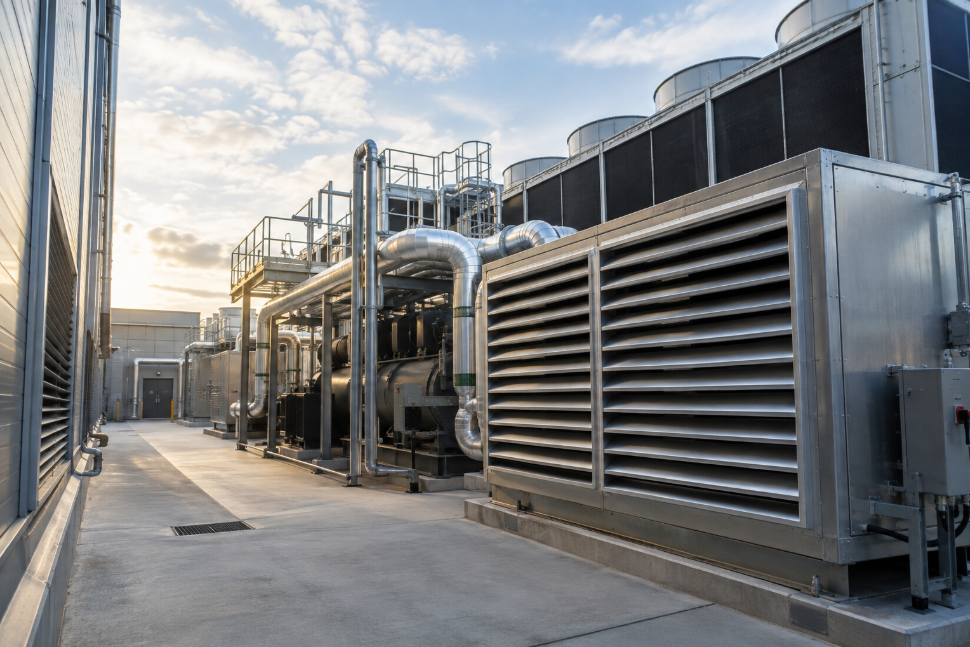
Mechanical systems introduce another version of the multiple-path problem. An air handling unit, or AHU, moves conditioned air through a building system, and AHUs, chillers, fans, and generators can send noise toward receivers through ductwork, ventilation openings, equipment housings, and direct outdoor paths.
Casing radiation is sound radiated directly through the equipment housing. Treating duct-borne noise alone can accomplish little if the housing or ventilation opening then becomes the loudest remaining path.
Which Product Fits Each Noise Path?
- Ducted airflow: A sound attenuator is installed in an airflow path to reduce sound traveling through a duct while allowing the system to continue moving air.
- Ventilation opening: When an equipment room or generator installation cannot simply be closed off, an acoustical louver can reduce sound through the opening while preserving required airflow.
- Radiated equipment noise: Sound coming directly through the equipment housing may call for acoustical panels or an enclosure when access, thermal needs, and service clearances permit.
- Outdoor sound path: For stationary chillers, generators, or similar equipment, favorable source-to-receiver geometry may make a barrier wall appropriate.
The correct airport noise reduction treatment may therefore involve more than one component around the same piece of equipment. Quieting the duct does little good if the casing, ventilation opening, or outdoor path becomes the dominant remaining source.
How Can Maintenance Hangar Noise Be Reduced?
Maintenance hangars can present two different problems at once: excessive reflected sound inside the space and noise escaping toward an exterior receiver. Large metal surfaces, concrete floors, high ceilings, and long reflective paths can create a harsh acoustic environment when tools, machinery, and maintenance equipment are operating.
Absorptive acoustical panels can reduce reflected energy when reverberation is the primary concern. The resulting interior can be easier to work and communicate in without implying that the building itself has been acoustically isolated.
When Is the Problem Noise Leaving the Hangar?
Noise leaving the hangar follows different paths. Large doors, ventilation openings, wall and roof construction, equipment locations, and localized sources can all affect an exterior receiver.
Reducing reverberation inside the hangar does not guarantee the same reduction outside. The treatment has to follow the complaint. Interior reflection problems point toward absorption, whereas a community receiver affected by a specific hangar source may require isolation, barriers, enclosures, or treatment at an opening.
Can Existing Airport Facilities Be Retrofitted for Noise Control?
Airport noise control can often be added to an existing facility, although available space, structure, airflow, access, and operating requirements limit what can be installed. A perimeter wall still needs useful source-to-receiver geometry, and mechanical treatments have to preserve the airflow and service access the equipment requires.
Existing airports also provide information that a new facility does not yet have. Actual source locations, operating schedules, complaint locations, and existing geometry can be observed and measured, allowing capital to be directed toward the controllable condition that is actually driving the problem. Targeted airport noise reduction is generally more defensible than applying the same treatment across every source on the site.
Assess Ground-Side Noise With Commercial Noise Control
Commercial Noise Control can help facility teams identify the dominant ground-side sources and determine which physical control strategy fits the operating conditions. That assessment can help avoid spending on treatment that does not address the sound path reaching the affected receiver. Contact us today for more information.
Frequently Asked Questions About Airport Ground Noise
These questions summarize several of the most common ground-side decisions facility managers, engineers, and consultants need to resolve.
What Is a Ground Run-Up Enclosure?
A ground run-up enclosure is a specialized acoustical structure built around an aircraft engine-test position. It reduces noise from high-power maintenance testing conducted on the ground.
How Much Noise Reduction Can an Airport Noise Barrier Provide?
There is no universal reduction figure for an airport noise barrier. FAA program criteria may require at least 5 dB for qualifying projects, but actual performance is determined by the source, receiver, and barrier geometry.
Why Is Terminal Noise an Acoustics Problem Rather Than a Soundproofing Problem?
Many terminal problems come from sound reflecting inside the space rather than transmitting through the building envelope. Absorption reduces those reflections and improves speech clarity, while sound isolation addresses transmission into or out of the space.
What Are the Main Sources of Airport Ground Noise?
Major ground-side sources include maintenance engine run-ups, apron and ground support equipment, stationary perimeter sources, mechanical and central plant equipment, terminal interior activity, and maintenance hangars. Effective airport noise reduction begins by identifying which source is actually reaching the affected receiver.
Can Airport Noise Control Be Added to an Existing Facility?
Yes. Many physical noise-control measures can be retrofitted when the existing structure, available space, airflow, access, sound path, and airport operations allow them.
Who Is Responsible for Airport Noise, the Airport or the Airlines?
Responsibility depends on the source. Airports handle many facility-side and ground-noise measures, operators make certain aircraft-operating decisions, and the FAA governs federal aviation functions such as airspace and flight procedures.